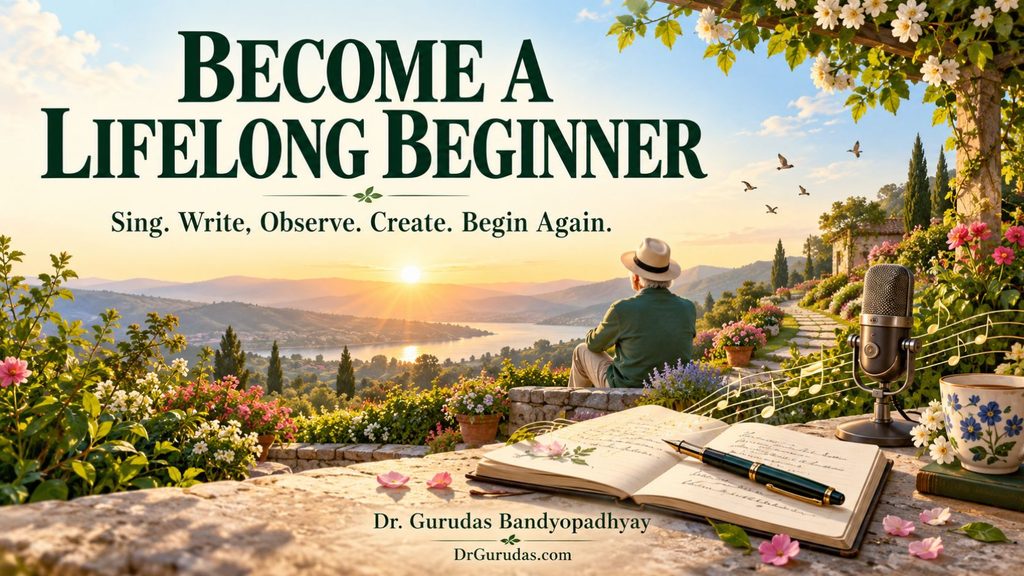
BECOME A LIFELONG BEGINNER
Keep Learning, Dare to Begin Again, and Make Every Stage of Life Meaningful
By Dr. Gurudas Bandyopadhyay
There are moments when life quietly asks us to become beginners again. A student enters an unfamiliar classroom. A professional accepts responsibilities beyond previous experience. A parent discovers that yesterday’s approach no longer suits a growing child. A retired person faces a morning without the familiar structure of work. An older adult learns a digital tool to remain connected with family.
Sometimes we welcome these beginnings. Sometimes we resist them. We may fear looking foolish, losing our confidence, or discovering how much we do not know. We may tell ourselves, “I should have learned this earlier,” or “At my age, why begin?”
Yet a meaningful life continues to offer opportunities to learn, adapt, create, and contribute. Our willingness to respond matters.
Becoming a lifelong beginner means remaining willing to learn wherever life requires a fresh response. It allows us to carry our experience forward while making room for new understanding.
1. What Does It Mean to Be a Lifelong Beginner?
A lifelong beginner approaches unfamiliar situations with curiosity, humility, and a willingness to practise. Such a person can say:
“I have experience, but there may be another way.”
“I do not understand this yet. Let me ask.”
“My first attempt needs improvement. What can it teach me?”
“This matters to me. I am willing to start small.”
We can be experienced in one area and beginners in another. A successful engineer may be learning how to write stories. A skilled teacher may be exploring digital teaching. A grandparent may be discovering how to communicate with a teenager whose world is very different.
Even within a familiar field, there is room to begin again. A writer who has completed many books may experiment with a new style. A manager may learn to listen more patiently. A musician may return to basic exercises to improve technique.
Experience gives us resources. Curiosity helps us discover where those resources need to grow.
Reflection
• Where does my experience help me?
• Where might it be making me too certain?
• What could I understand better if I approached it with fresh attention?
2. Give Yourself Permission to Be Inexperienced
One obstacle to beginning is the belief that competence should appear immediately.
We admire a confident speaker but seldom see the early rehearsals. We enjoy a polished article without seeing the revisions. We notice someone’s ease with technology without knowing how often that person asked for help.
When we compare our first attempt with another person’s established ability, we can become discouraged before learning has properly begun.
Imagine a retired professional joining a drawing class. During the first session, others produce recognisable sketches while his drawing seems awkward. He feels tempted to leave.
A useful question changes his response: “What did I come here to learn?”
He chooses one manageable task—observing shapes more carefully. His drawing remains imperfect, but he now has a direction for practice.
Permission to be inexperienced makes room for improvement.
This permission should include asking basic questions, working slowly, accepting guidance, and making corrections. It also includes choosing a setting where beginners are treated respectfully.
A practical strategy
Before starting something unfamiliar, complete this sentence:
“For the next few weeks, I give myself permission to be a learner in ______.”
Then identify what reasonable progress would look like. It might be completing a short lesson, understanding a basic process, or practising consistently.
3. Choose a Beginning That Matters to You
Life offers more possibilities than any person can pursue. Meaningful growth requires selection.
Before committing to a new activity, ask:
• Does this interest me?
• Does it meet a real need?
• Could it strengthen my independence or relationships?
• Could it help me contribute?
• Can I give it enough time and attention?
Suppose someone feels pressured to learn several new digital platforms. The task becomes overwhelming. However, her immediate purpose is simple: she wants to make video calls to her grandchildren.
That purpose provides a clear starting point. She can learn one application, practise with a trusted person, and keep a short written guide nearby. Other skills can follow when needed.
A worthwhile beginning may be modest. Learning to prepare a meal, manage a household record, grow herbs, or listen without interrupting can make daily life more meaningful.
The value of a beginning lies partly in what it makes possible in your life.
Reflection
“What would I like this learning to help me do, experience, or contribute?”
A clear answer can sustain effort when the novelty fades.
4. Begin Again at Different Stages of Life
Life stages differ in their responsibilities, opportunities, and constraints. The strategies below are flexible starting points; people reach milestones at different ages, and several transitions may overlap.
Life stage A meaningful beginning A useful approach
Childhood and adolescence Exploring interests, learning cooperation, developing study habits Encourage questions, manageable challenges, and freedom to try different activities.
Early adulthood Entering work, managing money, building independent routines Learn essential skills, seek guidance, and review choices through experience.
Middle adulthood Adapting to changing work and family responsibilities Select one priority and practise within the time and energy available.
Later career and the transition to retirement Developing interests and roles beyond employment Explore possibilities gradually and build a sustainable weekly rhythm.
Older adulthood Learning for connection, independence, enjoyment, and contribution Choose accessible activities, an appropriate pace, and useful support.
Any stage involving disruption Rebuilding after loss, relocation, illness, or a setback Attend to immediate needs, accept support, and take manageable steps.
Childhood and Adolescence: Explore Without Fixing Identity Too Early
A young person who struggles with mathematics may conclude, “I am bad at maths.” A child who hesitates to speak may decide, “I am not confident.”
Adults can help by describing the specific difficulty and the next step: “This kind of problem is unfamiliar. Let us work through one example.”
Encourage young learners to explore, ask questions, and notice improvement. Avoid making every activity a competition or a test of future success.
A child may begin again several times while learning to read, play a sport, or work with classmates. Patient guidance helps each attempt become part of learning.
Early Adulthood: Learn Through Responsible Experiments
Early adulthood often brings decisions about education, work, relationships, and independent living. Few people feel prepared for every responsibility.
A young professional may discover that a chosen role does not suit their strengths. Before making a major change, they can investigate alternatives, speak with experienced people, and try a small project.
Useful beginnings include learning to budget, communicate clearly, ask for feedback, and organise daily responsibilities.
The guiding question is:
“What can I test responsibly before making a larger commitment?”
Middle Adulthood: Make Growth Fit Real Life
Work, parenting, caregiving, and financial responsibilities can leave little space for learning. A new beginning needs to fit these circumstances.
Consider a working parent who wants to learn a language. An ambitious daily schedule repeatedly fails. A more workable approach might involve ten minutes of practice four days a week, with occasional conversation practice.
Relationships also require fresh learning. A parent whose child becomes a young adult may need to begin again as a listener—offering advice more thoughtfully and respecting growing independence.
At this stage, ask:
“What small change could improve an important part of my life without overwhelming my existing responsibilities?”
Retirement: Build a New Rhythm of Purpose
Retirement can create space for activities that employment left little time to pursue. It can also require adjustment in identity, routine, and social connection.
A former supervisor might mentor younger workers. A teacher might support community learning. Someone with no wish to continue their professional role might explore gardening, local history, music, or volunteering.
Try an activity for a limited period and observe how it fits. Does it bring interest? Does it provide useful connection? Is the commitment sustainable?
A purposeful week can include learning, relationships, practical responsibilities, rest, and contribution. It need not reproduce the demands of a working life.
Older Adulthood: Begin with What Is Possible Now
Later life may bring changes in energy, mobility, sensory abilities, or family circumstances. These changes deserve practical consideration when choosing activities.
Someone who finds long outings difficult might explore shorter visits, home-based creativity, or online participation. Another person might record family memories, learn to share photographs, or guide a younger learner.
A beginning can be adapted in pace, format, and duration. Written instructions, larger text, patient guidance, or shorter sessions may make learning more accessible.
The useful question becomes:
“Given my present circumstances, what would be a worthwhile and workable next step?”
There is dignity in learning at a pace that suits your life.
5. You May Need to Begin Again Within the Same Life Stage
We sometimes imagine that each life stage has one major beginning: education, employment, marriage, parenthood, or retirement. Daily life is more complicated.
Within the same stage, circumstances change. A professional may need to learn several new systems. A parent may need different approaches with different children. A retired person may revise plans after relocation. A writer may need a fresh routine after completing one project and starting another.
Repeated beginnings can follow interrupted practice as well.
Suppose someone begins writing every morning, maintains the routine for a month, and then stops during a period of family responsibilities. Returning to writing does not require treating the earlier month as wasted. The experience provides useful information: what time worked, what obstacles appeared, and what support might help.
You return with experience, even when you need to rebuild momentum.
A five-step approach to restarting
1. Recognise what changed. Identify the circumstances that interrupted your effort.
2. Keep what you learned. Retain useful skills, notes, and workable methods.
3. Adjust the plan. Change the timing, workload, or support where necessary.
4. Restart with a manageable task. Make the first return achievable.
5. Review after a short period. Decide what to continue or revise.
Beginning again becomes more useful when it includes reflection. Repeating an unsuitable plan without adjustment can reproduce the same difficulty.
6. Combine Openness with Mature Judgment
A beginner’s mind should include thoughtful evaluation.
When encountering a new idea, course, tool, or opportunity, consider its usefulness, credibility, cost, and suitability. Seek reliable guidance where the consequences of a mistake could be significant.
For example, an aspiring writer may use an unfamiliar digital tool to explore possible article outlines. The tool can support experimentation, while the writer remains responsible for checking facts and choosing the final wording.
Likewise, a new learning method may sound attractive but fit poorly with someone’s schedule or needs. Trying it on a small scale can provide information before a larger commitment.
Curiosity invites exploration. Judgment helps us decide what deserves further effort.
Reflection
• What evidence or experience supports this idea?
• What would trying it require?
• Can I begin on a small scale?
• Whose guidance would help me evaluate it?
7. Learn Across Generations
A lifelong beginner can learn from people of different ages.
A younger person may help an older relative use a digital service. An older person may explain how they handled difficult responsibilities. Both may discover something through a shared activity.
Consider a grandparent and grandchild preparing a family recipe. The grandparent shares the technique and the memories behind it. The grandchild records the process and creates a digital recipe page. Each contributes knowledge; each learns.
Such exchanges work best when both people remain curious and respectful. Experience deserves attention, and new perspectives deserve a fair hearing.
Try asking:
“What do you know that I could learn from you—and what might I share that would help you?”
8. Stay Long Enough to Develop
Starting often brings enthusiasm. Practice can feel slower and less exciting. A lifelong beginner needs patience as well as curiosity.
After an awkward first attempt, ask a specific question. Instead of “Am I any good at this?” try:
• What part was difficult?
• What improved?
• What feedback would help?
• What should I practise next?
A new speaker might focus first on delivering a clear two-minute message. A gardener might learn to care for one plant. A writer might improve one paragraph.
Small, specific practice gives attention a direction.
There are also times to change or stop a pursuit. An activity may no longer serve a useful purpose, or its demands may outweigh its value. Review the decision carefully. Temporary discomfort and poor fit are different experiences.
Reflection
“Does this pursuit still matter to me, and what would help me give it a fair opportunity to develop?”
9. Turn Learning into Contribution
Learning can bring enjoyment, capability, and independence. It can also strengthen our contribution to others.
A person who learns to organise photographs might help preserve family history. Someone who develops patient listening may improve relationships. A professional learning a new teaching method may make knowledge more accessible.
Contribution does not require mastery or a large audience. We can share a useful lesson honestly, help with a practical task, or learn alongside another person.
The important question is:
“How could what I am learning become useful beyond myself?”
This question gives learning a wider purpose while allowing personal enjoyment to remain valuable in its own right.
10. A Seven-Day Begin-Again Exercise
Choose one meaningful activity. Keep its scope small enough to explore within your present circumstances.
Day Exercise
1 — Choose Identify one activity you want to begin or resume. Write why it matters.
2 — Understand List what you already know and what you need to learn next.
3 — Prepare Gather one useful resource or ask one person for guidance.
4 — Attempt Complete a small first task without expecting a polished result.
5 — Reflect Record what worked, what was difficult, and one question that emerged.
6 — Adjust Repeat the task with one deliberate improvement.
7 — Continue Decide on a realistic next step and when you will take it.
At the end of the week, reflect:
• What did I discover about the activity?
• What did I discover about myself?
• Which support or adjustment helped?
• What would meaningful progress look like over the next month?
The exercise is a starting point. Its value grows when reflection shapes continued practice.
Keep the Door Open
A meaningful life can include many beginnings: chosen beginnings, unexpected beginnings, and returns to something once interrupted.
At each stage, we can ask what needs learning, what deserves attention, and what remains possible. We can use our experience, seek help, practise patiently, and contribute in ways that fit our circumstances.
You may begin several times within the same year, the same role, or the same relationship. Each beginning offers an opportunity to respond more thoughtfully.
Choose one worthwhile step today. Ask the question. Open the lesson. Resume the paragraph. Practise the conversation. Invite guidance.
“Let your experience guide you, your curiosity renew you, and every new beginning deepen your contribution to life.”
— Dr. Gurudas Bandyopadhyay
“I wish to begin again—to sing better, write and recite poems, see nature and life from fresh perspectives, and bring a little creativity into every day.”
— Dr. Gurudas Bandyopadhyay
Beginning again with music, poetry, and fresh eyes for nature. I am learning, practicing, and enjoying the journey—one creative day at a time.

What would you love to begin again?
#LifelongBeginner #BeginAgain #LifelongLearning #Creativity