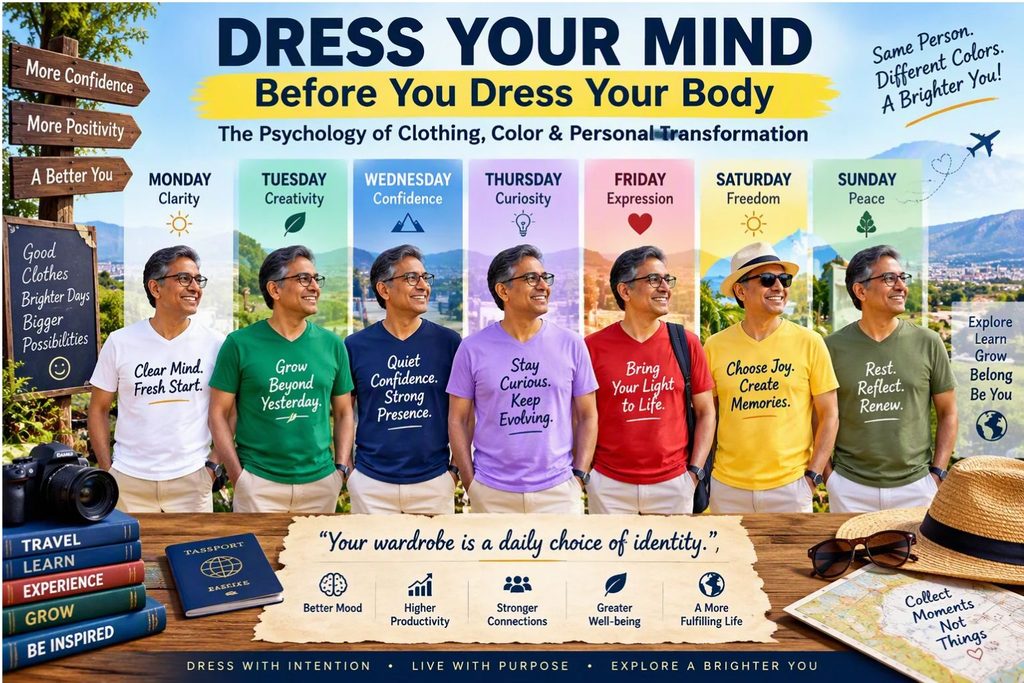
Dress Your Mind Before You Dress Your Body
The Hidden Psychology of Clothing, Color, Confidence, and Personal Transformation
Inspiring Quotes
“We do not merely wear clothes; we wear identities. Every morning, our wardrobe quietly asks: Who will you become today?”
“Clothing is not just fabric on the body. It is an environment for the mind.”
“Dress for the person you are becoming, not merely for the person you have been.”
Introduction: Your Clothes Are Talking Before You Do
Most people think of clothing as a practical necessity. We wear clothes to stay comfortable, protect ourselves from the weather, and present ourselves appropriately. Yet clothing does far more than cover the body.
Long before we speak a word, our appearance communicates messages about our personality, confidence, intentions, and state of mind. More importantly, clothing also influences how we think about ourselves.
Have you ever noticed that you feel different when wearing a crisp white shirt compared to an old worn-out T-shirt? Have you experienced greater confidence when dressing well for a special event? Have certain colors lifted your mood or altered your mindset?
These experiences are not imaginary. They reveal a fascinating concept known as the psychology of dressing, the study of how clothing and color influence human behavior, thought, emotion, and identity.
Dressing Is an Invisible Form of Self-Programming
Every day begins with a simple choice:
What will I wear today?
Most people believe they are merely selecting clothes. In reality, they may be selecting a mindset.
A neatly chosen outfit signals readiness.
A professional outfit signals competence.
Comfortable clothing signals relaxation.
Athletic clothing signals movement and action.
The brain constantly responds to environmental cues, and clothing becomes one of the most personal cues we experience throughout the day.
When you dress intentionally, you are sending a message not only to others but also to yourself.
That message might be:
• Today is a day to create.
• Today is a day to lead.
• Today is a day to learn.
• Today is a day to connect.
• Today is a day to rest.
The wardrobe becomes a silent coach guiding your behavior.
The Science Behind It: Enclothed Cognition
Psychologists use the term enclothed cognition to describe how clothing influences mental processes.
When people wear clothing associated with a specific role or identity, they often begin adopting behaviors that align with that role.
For example:
• A business professional may feel more confident when dressed professionally.
• A fitness enthusiast may feel more motivated in workout attire.
• A traveler wearing adventure-themed clothing may feel more open to exploration.
• A writer may feel more creative when dressed comfortably yet purposefully.
The clothes themselves do not create ability.
They influence mindset.
And mindset influences behavior.
The Powerful Language of Colors
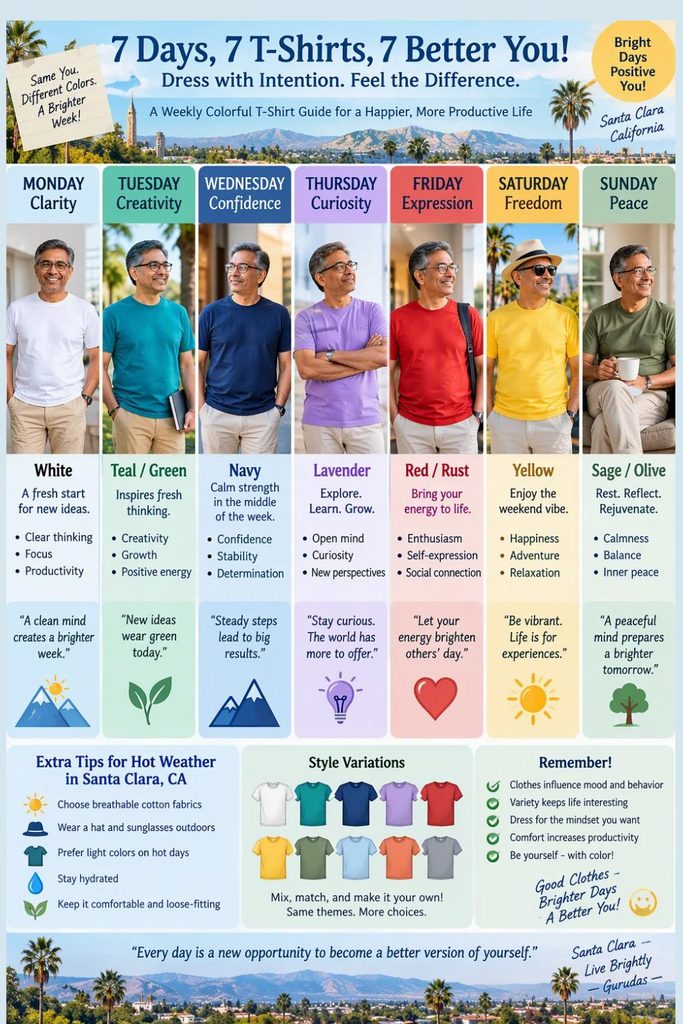
Colors communicate emotions long before words appear.
White: Clarity and Fresh Beginnings
White symbolizes:
• Simplicity
• Clarity
• Purity
• New starts
This makes it an excellent choice for Mondays, project launches, or days requiring focus and concentration.
Green: Growth and Creativity
Green represents:
• Nature
• Renewal
• Learning
• Possibility
Wearing green often supports a mindset of curiosity and innovation.
Navy Blue: Confidence and Stability
Blue is associated with:
• Trust
• Reliability
• Calm strength
Many leaders naturally gravitate toward blue because it communicates confidence without aggression.
Lavender: Curiosity and Imagination
Purple tones stimulate:
• Creativity
• Exploration
• Reflection
Perfect for brainstorming and learning days.
Red: Energy and Expression
Red symbolizes:
• Passion
• Action
• Confidence
When you want to project enthusiasm and vitality, red can be remarkably effective.
Yellow: Joy and Optimism
Yellow evokes:
• Happiness
• Adventure
• Positivity
It naturally aligns with leisure, exploration, and social connection.
Sage and Olive: Peace and Balance
These gentle natural tones support:
• Reflection
• Serenity
• Emotional balance
Ideal for weekends, recovery, and personal renewal.
A Weekly Color Psychology System
One way to bring intention into everyday dress is to assign a theme to each day.
Monday: Clarity
White “Clear Mind. Fresh Start.”
Tuesday: Creativity
Green “Grow Beyond Yesterday.”
Wednesday: Confidence
Navy Blue “Quiet Confidence. Strong Presence.”
Thursday: Curiosity
Lavender “Stay Curious. Keep Evolving.”
Friday: Expression
Red “Bring Your Light to Life.”
Saturday: Freedom
Yellow “Choose Joy. Create Memories.”
Sunday: Peace
Sage Green “Rest. Reflect. Renew.”
This simple system transforms dressing from a routine into a daily psychological ritual.
Clothing as an Investment
People often ask:
“Is buying good clothing an expense or an investment?”
The answer depends on the purpose.
When clothing merely satisfies temporary impulses, it is often an expense.
When clothing improves:
• Confidence
• Presence
• Comfort
• Productivity
• Personal image
it becomes an investment.
The return may not always be financial.
Sometimes the return is greater self-respect.
Sometimes it is increased motivation.
Sometimes it is simply the confidence to pursue opportunities you might otherwise avoid.
Travel and the Psychology of Adventure
The psychology of dressing becomes especially powerful while traveling.
Imagine wearing a T-shirt with the caption:
“Objects in Motion Tend to Stay in Motion.”
or
“Travel Far. Grow Deeper.”
Such clothing does more than start conversations.
It reminds the wearer that travel is not merely about changing locations.
It is about expanding perspectives.
The best travel attire reflects curiosity, learning, and openness to new experiences.
Dressing for Your Future Self
One of the most transformative concepts in psychology is identity-based growth.
Instead of asking:
“What should I wear today?”
Ask:
“Who do I want to become today?”
A future author dresses differently from someone who has given up on learning.
A future leader dresses differently from someone who avoids responsibility.
A future athlete dresses differently from someone who remains inactive.
This does not mean buying expensive clothing.
It means dressing intentionally.
Your wardrobe can become a bridge between your current self and your future self.
Final Thoughts: Your Wardrobe Is a Daily Choice of Identity
Most people underestimate the power of clothing.
Yet every morning, before making a single important decision, they choose what to wear.
That choice influences:
• Mood
• Confidence
• Energy
• Behavior
• Presence
• Interactions
Clothing cannot replace character.
Color cannot replace competence.
Fashion cannot replace purpose.
But intentional dressing can reinforce all three.
The next time you open your wardrobe, remember:
“A well-designed wardrobe is not a collection of clothes. It is a collection of moods, identities, possibilities, and intentions.”
Dress comfortably. Dress authentically. Dress intentionally.
And whenever possible,
dress for the person you are becoming.