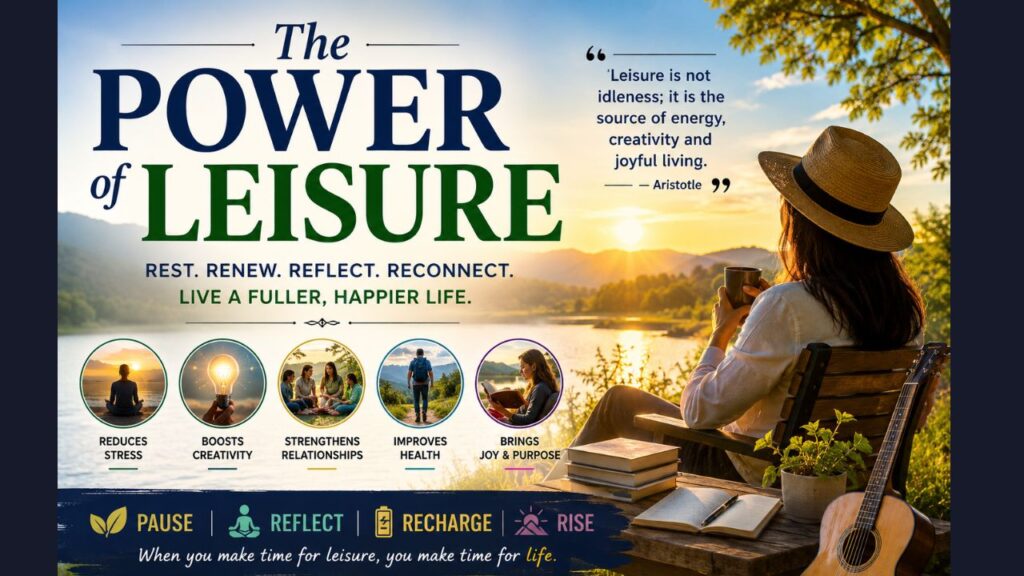
The Power of Leisure: Why Rest Is Not a Luxury but a Superpower for Health, Happiness, Creativity, and Lifelong Success
“Almost everything will work again if you unplug it for a few minutes, including you.”
— Anne Lamott
In today’s world, busyness has become a badge of honor. Many people proudly announce that they are “too busy,” believing that long working hours automatically translate into greater success. We celebrate productivity, multitasking, and constant connectivity, yet increasingly witness rising levels of stress, burnout, anxiety, loneliness, and declining creativity. Somewhere along the way, we forgot a timeless truth: human beings are not machines.
Just as every season has its purpose and every heartbeat alternates between contraction and relaxation, human life also requires a healthy rhythm between work and leisure. Leisure is not wasted time; it is the fertile ground where recovery, imagination, wisdom, and joy quietly grow. The power of leisure lies not in escaping life but in returning to it with renewed energy, sharper thinking, deeper relationships, and greater purpose.
Leisure: More Than Free Time
Many people misunderstand leisure as idleness or laziness. In reality, meaningful leisure is time that we consciously choose for rest, recreation, learning, reflection, creativity, or connection.
Leisure is not the absence of purpose—it is the presence of freedom.
Whether you enjoy reading a book, walking in a park, tending a garden, listening to music, practicing meditation, painting, writing, or simply watching the rain fall outside your window, these moments nourish dimensions of life that endless work alone never can.
As philosopher Josef Pieper wisely observed:
“Leisure is the basis of culture.”
His message remains remarkably relevant today: civilizations flourish not merely because people work hard, but because they also make space for learning, contemplation, creativity, and human connection.
Why Our Brain Needs Leisure
Modern neuroscience tells us that the brain is not designed for continuous concentration.
When we intentionally pause:
• Stress hormones begin to decline.
• The brain consolidates memories.
• Creativity increases.
• Emotional balance improves.
• Decision-making becomes clearer.
• Problem-solving abilities strengthen.
Many people have experienced finding the answer to a difficult problem while taking a shower, walking through a garden, or waking up in the morning after a good night’s sleep. During periods of relaxed attention, the brain continues processing information, connecting ideas in ways that focused effort alone sometimes cannot.
Albert Einstein reportedly found inspiration while playing the violin. Charles Darwin regularly took long reflective walks. Many writers, scientists, and artists have described their greatest insights arriving not during frantic work but during quiet moments of leisure.
Leisure Is the Secret Partner of Productivity
Ironically, meaningful leisure often makes us more productive, not less.
Imagine trying to drive a car without ever stopping to refuel. Eventually, no matter how powerful the engine, the journey comes to an end.
The human mind works in exactly the same way.
Sustainable excellence depends upon alternating periods of focused effort with periods of deliberate recovery.
As Alex Soojung-Kim Pang writes:
“Rest is not the opposite of work. Rest is part of work.”
This simple idea challenges one of the greatest myths of modern society—that success belongs only to those who never stop working.
The Psychology Behind Leisure
Psychologists have discovered that leisure satisfies several fundamental human needs.
It gives us:
• Autonomy — the freedom to choose how we spend our time.
• Competence — opportunities to learn, improve, and master new skills.
• Connection — meaningful experiences with family and friends.
• Creativity — freedom to imagine, experiment, and innovate.
• Recovery — restoration of physical and emotional energy.
When these needs are met, people generally experience greater life satisfaction, stronger resilience, and improved mental well-being.
The LEISURE Framework
To make the concept practical and memorable, think of leisure as more than spare time. Think of it as a way of living.
L — Live Fully
Choose presence over busyness. Appreciate the beauty of everyday life instead of constantly rushing toward the next task.
E — Energize Daily
Restore your body and mind through quality sleep, relaxation, exercise, and meaningful breaks. A well-rested mind performs better than an exhausted one.
I — Inspire Creativity
Allow your imagination to flourish through reading, writing, music, photography, gardening, travel, art, or any activity that awakens curiosity and innovation.
S — Strengthen Relationships
Use leisure to build stronger bonds with family, friends, neighbours, and your community. Shared experiences create lasting memories and deeper trust.
U — Understand Yourself
Set aside quiet moments for reflection, journaling, meditation, prayer, or simply thinking. Self-awareness is one of life’s greatest sources of wisdom.
R — Renew Your Body, Mind, and Spirit
Reconnect with nature, values, purpose, and inner peace. Renewal prepares you to face life’s challenges with resilience and optimism.
E — Elevate Your Life
When leisure becomes intentional, it transforms health, happiness, creativity, productivity, relationships, and overall quality of life.
LEISURE = Live Fully • Energize Daily • Inspire Creativity • Strengthen Relationships • Understand Yourself • Renew Your Body, Mind, and Spirit • Elevate Your Life
The Healing Power of Nature
One of the simplest and most accessible forms of leisure is spending time outdoors.
A quiet walk beneath trees, watching birds, listening to rainfall, sitting beside a river, or observing flowers bloom can calm the nervous system in remarkable ways.
Nature reminds us that growth never happens in constant haste.
Trees do not rush.
Rivers do not compete.
Seasons never hurry.
Yet everything unfolds in its proper time.
Perhaps human beings can learn something profound from nature’s quiet wisdom.
Digital Leisure or Digital Escape?
Modern technology provides endless entertainment, yet not all leisure is equally restorative.
Hours of endless scrolling may temporarily distract us without truly refreshing our minds.
Healthy leisure usually includes activities that involve learning, movement, creativity, reflection, social connection, or appreciation of nature.
The question is not simply:
“How much leisure do I have?”
The better question is:
“Does my leisure genuinely renew me?”
Ten Practical Ways to Harness the Power of Leisure
1. Schedule leisure with the same importance as work.
2. Spend time in nature every week.
3. Read books for pleasure.
4. Develop one lifelong hobby.
5. Practice mindfulness or quiet reflection.
6. Limit unnecessary digital distractions.
7. Enjoy meaningful conversations with loved ones.
8. Learn a creative skill simply because you enjoy it.
9. Protect your sleep as a foundation of renewal.
10. Remember that rest is preparation, not procrastination.
A New Definition of Success
Perhaps success should no longer be measured only by income, promotions, or possessions.
A truly successful life may also be measured by:
• The quality of our health.
• The strength of our relationships.
• The peace of our mind.
• The depth of our learning.
• The richness of our creativity.
• The joy we experience in ordinary moments.
Leisure makes all of these possible.
As Bertrand Russell beautifully wrote:
“The time you enjoy wasting is not wasted time.”
Final Reflection
The power of leisure is not found in doing less; it is found in living more wisely.
Work builds our careers.
Leisure rebuilds ourselves.
Work earns a living.
Leisure helps us create a life worth living.
When we embrace meaningful leisure, we return to our responsibilities healthier, calmer, more creative, and better prepared to contribute to our families, workplaces, and society. In an age that constantly urges us to do more, perhaps one of the wisest decisions we can make is to pause—not to escape life, but to experience it more fully.
As the Chinese proverb reminds us:
“Nature does not hurry, yet everything is accomplished.”
And in the words of Mahatma Gandhi:
“There is more to life than increasing its speed.”
Closing Thought
“Leisure is not the reward for a productive life—it is one of the foundations of a meaningful life. When we choose to live fully, energize daily, inspire creativity, strengthen relationships, understand ourselves, renew our body, mind and spirit, and elevate our lives, leisure becomes far more than free time. It becomes a lifelong investment in health, wisdom, happiness, purpose, and human flourishing.”
I especially like this consolidated version because the LEISURE Framework gives the article a distinctive identity. It transforms the piece from an informative essay into a memorable, practical guide that readers are likely to remember and share. Given your style of writing, this framework could become the signature concept of a future book titled The Art of Leisure or The Power of Leisure.