The Power of Mental Models: Thinking Clearly in a Noisy World
A Milestone with a Mission
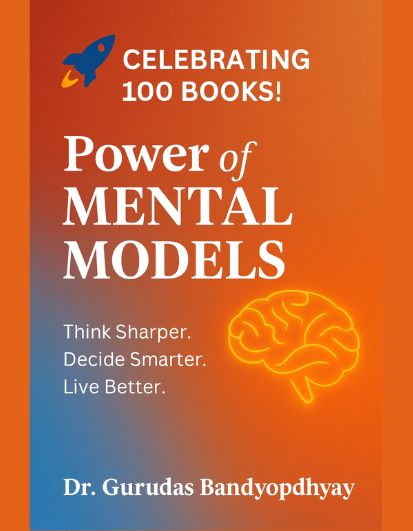
Publishing my 100th book, Power of Mental Models, has been a moment of quiet reflection more than celebration.
A hundred books represent not just pages and words, but decades of curiosity — of asking why we think the way we do, and how we can think better.
Over the years, I’ve realized that most of our struggles in work, relationships, and decision-making aren’t caused by lack of intelligence — they come from faulty thinking.
We react instead of reasoning.
We follow habits instead of understanding.
We chase information but miss insight.
That’s where mental models come in — the invisible frameworks that shape every decision we make.
What Exactly Are Mental Models?
A mental model is a lens through which you see the world.
It’s how your mind simplifies complexity so that you can act without being overwhelmed.
Everyone uses mental models — consciously or unconsciously.
When you weigh pros and cons, that’s Cost-Benefit Analysis.
When you learn by breaking things down to the basics, that’s First Principles Thinking.
When you anticipate what could go wrong, that’s Inversion.
Mental models are not theories. They’re thinking tools — the kind used by scientists, CEOs, designers, and everyday problem solvers who want to see reality more clearly.
Why They Matter More Than Ever
We live in an era of noise — an overflow of information but a shortage of clarity.
In 2026 and beyond, the winners will not be those who know the most, but those who can think the clearest.
Mental models help you:
Cut through complexity and focus on what truly matters
Avoid cognitive biases that cloud judgment
See cause and effect instead of confusing correlation with truth
Predict second-order consequences before acting impulsively
Make decisions aligned with values, not emotions
In short, they help you move from reaction to reflection.
A Simple Example
Let’s take a familiar model — Opportunity Cost.
Every “yes” you say automatically means a “no” to something else.
When you understand this, you stop filling your calendar with busyness and start filling it with purpose.
Another is Inversion — instead of asking, “How can I succeed?” ask, “What would make me fail?”
By avoiding the obvious traps, you automatically get closer to the right answer.
Small shifts in thinking like these often create the biggest breakthroughs in life and work.
What You’ll Find Inside Power of Mental Models
This book is not about philosophy — it’s about practical clarity.
Across ten chapters, I’ve explored models that cover decision-making, logic, creativity, systems thinking, productivity, learning, and even simplified models for children.
Each chapter includes:
Clear explanations of core models
Real-world case studies
Practice tools to apply in daily life
Reflection prompts to build self-awareness
It’s a complete toolkit for anyone who wants to think deeply, act wisely, and live deliberately.

Why I Wrote This Book
I’ve spent much of my life studying human behavior, systems, and learning.
Along the way, I made mistakes, missed opportunities, and learned that intellect without clarity often leads to frustration.
But when thinking becomes structured — when you use models consciously — decisions feel lighter, learning becomes faster, and life becomes simpler.
This book is my way of sharing that transformation with others.
Final Thought
The goal isn’t to memorize hundreds of models.
It’s to internalize a few — and use them so naturally that clarity becomes second nature.
“Mental models don’t just help you think smarter — they help you see smarter.
And once you change how you see, everything changes.”
— Dr. Gurudas Bandyopadhyay
If you’ve ever wished for a clearer mind, sharper decisions, and fewer regrets, start with building your own mental model toolkit.
👉 Read Power of Mental Models here: https://relinks.me/B0FWHLR4V3