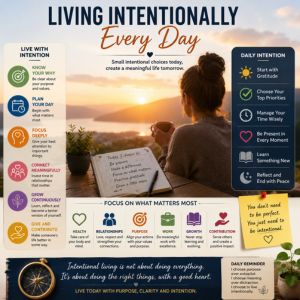
Living Intentionally Every Day: How Small Choices Create a Meaningful Life
Most of us want to live a meaningful life. We want good health, loving relationships, purposeful work, continuous growth, inner peace, and the satisfaction of knowing that our presence has made some positive difference. Yet meaning is rarely created by one extraordinary achievement. It is built quietly through the way we live ordinary days.
Every morning gives us another portion of life. How we use our time, where we place our attention, what we think about, whom we care for, what we learn, what we create, and how we respond to challenges gradually shape the person we become. This is the essence of intentional living.
“Do not merely plan a meaningful life. Live a meaningful day—and repeat.” — Dr. Gurudas Bandyopadhyay
What Does Living Intentionally Mean?
Intentional living means choosing how we want to live instead of allowing circumstances, habits, distractions, social pressures, and other people’s expectations to make every choice for us.
It does not mean controlling everything. Life will always contain uncertainty. Unexpected events occur. Plans fail. Relationships change. Health fluctuates. Opportunities appear and disappear.
Intentional living means recognizing the difference between what we cannot control and what we can consciously influence.
We may not control every event, but we can often choose our response. We may not control how other people behave, but we can choose our own conduct. We cannot create more than twenty-four hours in a day, but we can decide what deserves more of those hours.
The fundamental question becomes:
Am I living by conscious choice—or mainly by default?
Know Your Why
Intentional living begins with clarity.
Ask yourself:
Who am I?
What matters most to me?
What kind of person do I want to become?
What contribution do I want to make?
How do I want the people closest to me to experience me?
What would make my life feel worthwhile when I eventually look back?
Without a clear why, we can become extremely busy while travelling in no meaningful direction.
Purpose acts like a compass. It does not tell us every turn we will encounter, but it helps us recognize whether we are broadly moving in the right direction.
Align Your Choices with Your Values
Most people have values such as health, family, integrity, learning, security, compassion, freedom, contribution, or personal growth.
But values become powerful only when they enter our behavior.
If we say health matters, does our lifestyle reflect it?
If family matters, do important people receive meaningful attention?
If learning matters, are we continuously developing ourselves?
If kindness matters, how do we treat people who can do nothing for us?
If purpose matters, does our calendar contain time for purposeful activities?
A useful progression is:
VALUES → PRIORITIES → CHOICES → ACTIONS → HABITS → CHARACTER → LIFE DIRECTION
Our values are therefore not merely what we believe. They should increasingly become visible in how we live.
Plan Your Day Around What Matters
Many people begin their morning by looking at their phones. Immediately, the outside world starts deciding what deserves their attention.
Messages arrive.
News appears.
Notifications demand responses.
Other people’s priorities enter our minds before we have considered our own.
Try reversing the process.
Before entering the day’s noise, ask:
What matters most today?
What is my Most Important Task?
Who deserves my attention?
What should I avoid being distracted by?
How do I want to behave today?
You do not need an elaborate morning ritual. Even five quiet minutes can shift the day from reaction to intention.
Manage Three Precious Resources: Time, Energy, and Attention
We frequently speak about time management, but meaningful living requires managing three resources simultaneously.
Time determines what receives a portion of our day.
Energy determines how strongly we can engage.
Attention determines how fully we are present.
You may spend an hour with someone you love, but if you spend most of that hour looking at your phone, you gave them time without much attention.
You may have two hours for important creative work, but if your energy is exhausted, the quality of that time may be poor.
A better question than simply “How much time do I have?” is:
“What deserves my best time, strongest energy, and deepest attention?”
Do not continually give your best resources to things that matter least.
Build Habits That Support the Life You Want
Purpose gives direction, but habits create momentum.
If you want better health, develop health-supporting habits.
If you want stronger relationships, create routines of listening, appreciation, and connection.
If you want knowledge, establish a learning habit.
If you want to make a difference, develop a habit of contribution.
The connection is powerful:
PURPOSE → ACTION → REPETITION → HABIT → CHARACTER → LIFE
Start small. A ten-minute walk is better than an ambitious exercise plan repeatedly abandoned. Five pages read daily can eventually become many books. A five-minute conversation with an elderly family member can become a treasured relationship ritual.
Consistency often matters more than intensity.
Focus Deeply
One of the greatest challenges of modern living is fragmented attention.
We attempt to work while checking messages. We talk to family while watching notifications. We consume information continuously while rarely stopping to think about it.
Intentional living requires periods of genuine presence.
When doing important work, work.
When listening, listen.
When learning, learn.
When resting, allow yourself to rest.
When spending time with someone you love, try to be there mentally as well as physically.
Where attention goes, a portion of life goes with it.
Protect attention accordingly.
Connect Meaningfully
A meaningful life cannot be reduced to personal achievement.
Human beings need relationships, belonging, care, friendship, and community.
Give important people more than leftover time.
Listen before advising.
Express appreciation while people can receive it.
Repair misunderstandings before they become permanent distance.
Respect boundaries.
Encourage other people’s growth.
Call someone you have neglected.
Spend time with older generations.
Listen to younger generations.
Meaning often emerges when we stop asking only:
“What am I achieving?”
and begin asking:
“Whose life is becoming better because I am here?”
Keep Learning and Growing
Intentional living requires continuous learning because neither we nor the world remain unchanged.
Read.
Observe.
Ask questions.
Learn from people younger and older than yourself.
Acquire new skills.
Reflect on mistakes.
Use technology and artificial intelligence thoughtfully.
Challenge outdated assumptions.
A useful lifelong cycle is:
LEARN → THINK → APPLY → REFLECT → IMPROVE → SHARE
Learning should not end with formal education. As long as we remain curious, life continues teaching us.
Give and Contribute
Contribution is one of the deepest dimensions of meaningful living.
You do not need enormous wealth, authority, or fame to contribute.
You can:
• teach someone,
• encourage someone,
• mentor a younger person,
• care for a family member,
• share useful knowledge,
• volunteer,
• solve a small community problem,
• support someone during difficulty,
• create something valuable.
Ask yourself each morning:
“Whose life can I make slightly better today?”
The answer may require only a few minutes.
Small acts of usefulness accumulated across decades can become a remarkable legacy.
Practice Gratitude
Intentional living is not only about improving what is missing. It is also about appreciating what already exists.
We become accustomed to:
our health,
our homes,
our relationships,
our food,
our freedom,
our abilities,
our opportunities,
another sunrise,
another day.
Gratitude interrupts this familiarity.
It says:
“This may be ordinary, but it is not therefore insignificant.”
Try identifying three things each evening for which you are genuinely grateful.
Better still, occasionally tell people why you appreciate them.
Gratitude that remains inside us is valuable. Gratitude expressed can strengthen another person’s life as well.
Make Better Decisions
Every meaningful yes contains a hidden no.
Saying yes to focused work may mean saying no to distraction.
Saying yes to health may require saying no to some unhealthy choices.
Saying yes to financial security may require refusing impulsive consumption.
Saying yes to family may mean declining some unnecessary commitments.
Before an important decision, ask:
Does this align with my values?
Does it support my purpose?
What will it cost in time, energy, health, money, or relationships?
What am I indirectly saying no to?
Will my future self respect this choice?
Purpose can become a powerful decision filter.
Leave Room for Joy
Intentional living should never turn life into an endless productivity project.
A meaningful life also contains:
rest, leisure, laughter, nature, friendship, hobbies, music, celebration, travel, curiosity and spontaneous moments.
You do not have to optimize every minute.
Sometimes sitting quietly beside a window, drinking tea, watching trees move in the wind, or walking through nature can be deeply meaningful.
Rest is not necessarily an interruption of meaningful living.
Sometimes rest itself is meaningful living.
The 5M Formula for a Meaningful Day
Here is a simple framework that almost anyone can remember.
MOVE
Do something for your physical well-being.
MIND
Learn, think, read, or reflect.
MEANING
Remember what matters and why.
MATTER
Advance at least one important priority.
MAKE A DIFFERENCE
Do something useful for another person.
MOVE → MIND → MEANING → MATTER → MAKE A DIFFERENCE
You do not need to spend hours on each. Small actions count.
Try the 1–1–1 Rule
If even the 5M system feels too elaborate, remember only three things.
Every day try to do:
1 thing for yourself — health, learning, reflection, or renewal.
1 thing for your purpose — move something meaningful forward.
1 thing for someone else — help, appreciate, encourage, listen, teach, or care.
That gives us:
SELF + PURPOSE + OTHERS = A MORE MEANINGFUL DAY
End the Day with Reflection
Before sleeping, spend five minutes asking:
What went well today?
What mattered most?
Was I aligned with my values?
What am I grateful for?
Whom did I help?
What did I learn?
What should I do differently tomorrow?
Reflection transforms experience into learning.
The objective is not to judge yourself harshly. It is to correct direction.
INTENTION → ACTION → REFLECTION → LEARNING → REALIGNMENT
This cycle, repeated over years, can profoundly influence a life.
You Do Not Need a Perfect Day
Some days will not go according to plan.
You may become tired.
An emergency may arise.
Someone may need you.
Work may take longer than expected.
You may simply have a difficult day.
Intentional living does not demand perfection.
On such days, ask:
“Given the day I actually have—not the day I wanted—what is the most meaningful thing I can do now?”
Sometimes the answer is to work.
Sometimes it is to help someone.
Sometimes it is to apologize.
Sometimes it is to rest.
Sometimes it is simply to begin again tomorrow.
A Seven-Day Intentional Living Challenge
For the next seven days, begin each morning by writing:
Today I am grateful for: ________
What matters most today: ________
My Most Important Task: ________
The person who deserves my attention: ________
Something useful I will learn: ________
One contribution I will make: ________
One distraction I will consciously reduce: ________
At night, ask one final question:
“Did I live today—or did I merely get through it?”
Do not worry about achieving a perfect score. Notice, learn, adjust, and continue.
Final Thoughts
We often imagine that the meaning of life is something hidden somewhere in the future, waiting to be discovered after we have achieved enough, earned enough, learned enough, or solved enough problems.
But perhaps part of the answer is much closer.
Meaning is being created today—in the work we perform, the people we love, the health we protect, the knowledge we acquire, the gratitude we express, the difficulties we face courageously, and the lives we enrich.
Your future matters.
Your dreams matter.
Your long-term purpose matters.
But today matters too, because today is where the future is being constructed.
“Clarity helps you see what deserves your day. Gratitude helps you recognize the value already within it. Intention helps you transform that awareness into action.” — Dr. Gurudas Bandyopadhyay
And perhaps the simplest principle worth carrying into tomorrow is:
Know what matters. Choose what matters. Do what matters. Appreciate what matters. Repeat.
That is the essence of Living Intentionally Every Day.
हर दिन उद्देश्यपूर्ण ढंग से जिएँ: छोटे–छोटे चुनाव कैसे एक सार्थक जीवन बनाते हैं
हममें से अधिकांश लोग एक सार्थक जीवन जीना चाहते हैं। हम अच्छा स्वास्थ्य, प्रेमपूर्ण संबंध, उद्देश्यपूर्ण कार्य, निरंतर विकास, आंतरिक शांति और यह संतोष चाहते हैं कि हमारे जीवन ने किसी न किसी रूप में दूसरों के जीवन को बेहतर बनाया है। लेकिन जीवन का अर्थ केवल किसी एक महान उपलब्धि, बड़ी सफलता या असाधारण घटना से नहीं बनता। वह धीरे-धीरे हमारे साधारण दिनों को जीने के तरीके से निर्मित होता है।
हर सुबह हमें जीवन का एक नया दिन मिलता है। हम अपना समय कैसे बिताते हैं, अपना ध्यान कहाँ लगाते हैं, क्या सोचते हैं, किसकी परवाह करते हैं, क्या सीखते हैं, क्या सृजन करते हैं और कठिन परिस्थितियों का सामना कैसे करते हैं—ये सभी मिलकर धीरे-धीरे तय करते हैं कि हम कौन बन रहे हैं।
यही है हर दिन उद्देश्यपूर्ण और सजग होकर जीने की कला—Intentional Living।
“केवल एक सार्थक जीवन की योजना मत बनाइए। आज के दिन को सार्थक बनाइए—और फिर इसे प्रतिदिन दोहराइए।” — डॉ. गुरुदास बंद्योपाध्याय
उद्देश्यपूर्ण जीवन जीने का अर्थ क्या है?
उद्देश्यपूर्ण जीवन का अर्थ है—अपना जीवन केवल परिस्थितियों, आदतों, सामाजिक दबावों, डिजिटल विचलनों और दूसरों की अपेक्षाओं के अनुसार न चलाकर, सचेत रूप से यह तय करना कि हम कैसे जीना चाहते हैं।
इसका अर्थ यह नहीं कि हम जीवन की हर घटना को नियंत्रित कर सकते हैं।
जीवन में अनिश्चितता रहेगी। योजनाएँ बदलेंगी। स्वास्थ्य में उतार-चढ़ाव आएगा। रिश्ते बदलेंगे। अप्रत्याशित समस्याएँ और अवसर सामने आएँगे।
लेकिन हमारे पास हमेशा कुछ न कुछ ऐसा रहता है जिसे हम प्रभावित कर सकते हैं—हमारी प्रतिक्रिया, प्राथमिकताएँ, व्यवहार, ध्यान और अगला कदम।
इसलिए स्वयं से पूछिए:
“क्या मैं अपना जीवन सचेत चुनावों से जी रहा हूँ, या केवल परिस्थितियों के अनुसार बहता जा रहा हूँ?”
अपना ‘क्यों’ पहचानिए
उद्देश्यपूर्ण जीवन की शुरुआत स्पष्टता से होती है।
स्वयं से पूछिए:
मैं कौन हूँ?
मेरे लिए वास्तव में क्या महत्वपूर्ण है?
मैं कैसा व्यक्ति बनना चाहता हूँ?
मैं दुनिया में क्या योगदान देना चाहता हूँ?
मैं चाहता हूँ कि मेरे निकटतम लोग मुझे किस रूप में याद करें?
जीवन के अंत में पीछे मुड़कर देखने पर किन बातों से मुझे लगेगा कि मेरा जीवन सार्थक था?
यदि हमारा WHY—‘क्यों’ स्पष्ट नहीं है, तो हम अत्यंत व्यस्त रहते हुए भी गलत दिशा में आगे बढ़ सकते हैं।
उद्देश्य जीवन के लिए एक कम्पास की तरह काम करता है।
अपने मूल्यों के अनुसार चुनाव कीजिए
हममें से अधिकांश कुछ मूल्यों को महत्वपूर्ण मानते हैं:
स्वास्थ्य, परिवार, ईमानदारी, सीखना, स्वतंत्रता, सुरक्षा, करुणा, विकास और योगदान।
लेकिन मूल्य तभी शक्तिशाली बनते हैं जब वे हमारे व्यवहार में दिखाई देते हैं।
यदि हम कहते हैं कि स्वास्थ्य महत्वपूर्ण है, तो क्या हमारी जीवनशैली इसे दर्शाती है?
यदि परिवार महत्वपूर्ण है, तो क्या हम उन्हें पर्याप्त समय और ध्यान देते हैं?
यदि सीखना महत्वपूर्ण है, तो क्या हम नियमित रूप से कुछ नया सीखते हैं?
यदि दयालुता महत्वपूर्ण है, तो हम उन लोगों के साथ कैसा व्यवहार करते हैं जिनसे हमें कोई लाभ नहीं मिलना है?
यदि जीवन का उद्देश्य महत्वपूर्ण है, तो क्या हमारे कैलेंडर में उसके लिए स्थान है?
इस प्रवाह को याद रखिए:
मूल्य → प्राथमिकताएँ → चुनाव → कार्य → आदतें → चरित्र → जीवन की दिशा
हमारे मूल्य केवल वे नहीं हैं जिनके बारे में हम बोलते हैं। वे धीरे-धीरे हमारे जीने के तरीके में दिखाई देने चाहिए।
दिन की शुरुआत महत्वपूर्ण बातों से कीजिए
बहुत से लोग सुबह उठते ही मोबाइल देखते हैं।
संदेश आते हैं।
समाचार सामने आते हैं।
नोटिफिकेशन ध्यान माँगते हैं।
दूसरों की प्राथमिकताएँ हमारे मन में प्रवेश कर जाती हैं—इससे पहले कि हम अपनी प्राथमिकताओं पर विचार करें।
इस क्रम को बदलकर देखिए।
दिन की भागदौड़ शुरू होने से पहले स्वयं से पूछिए:
आज मेरे लिए सबसे महत्वपूर्ण क्या है?
आज का मेरा Most Important Task क्या है?
आज किस व्यक्ति को मेरे पूरे ध्यान की आवश्यकता है?
मुझे किस विचलन से बचना चाहिए?
आज मैं किस प्रकार का व्यक्ति बनकर जीना चाहता हूँ?
इसके लिए एक घंटे की आवश्यकता नहीं है।
सुबह के केवल पाँच शांत मिनट भी दिन को Reactive से Intentional बना सकते हैं।
जीवन के तीन बहुमूल्य संसाधन
हम अक्सर Time Management की बात करते हैं। लेकिन सार्थक जीवन के लिए तीन संसाधनों का प्रबंधन आवश्यक है:
समय — TIME
मैं अपने जीवन के घंटे कहाँ लगाऊँगा?
ऊर्जा — ENERGY
मैं अपनी सर्वोत्तम क्षमता कहाँ लगाऊँगा?
ध्यान — ATTENTION
मैं मानसिक रूप से कहाँ उपस्थित रहूँगा?
आप अपने परिवार के साथ एक घंटा बिता सकते हैं, लेकिन यदि अधिकांश समय मोबाइल देखते रहें, तो आपने उन्हें समय तो दिया—पर पूरा ध्यान नहीं दिया।
इसलिए केवल यह मत पूछिए:
“मेरे पास कितना समय है?”
पूछिए:
“मेरे सर्वोत्तम समय, ऊर्जा और ध्यान का वास्तविक अधिकारी कौन या क्या है?”
जो सबसे कम महत्वपूर्ण है, उसे अपने जीवन का सर्वोत्तम हिस्सा मत दीजिए।
ऐसी आदतें बनाइए जो आपके इच्छित जीवन का निर्माण करें
उद्देश्य दिशा देता है।
आदतें गति देती हैं।
यदि आप स्वस्थ जीवन चाहते हैं, तो स्वास्थ्य-सहायक आदतें बनाइए।
यदि मजबूत रिश्ते चाहते हैं, तो सुनने, संवाद और सराहना की आदत विकसित कीजिए।
यदि ज्ञान चाहते हैं, तो नियमित सीखने की आदत बनाइए।
यदि योगदान देना चाहते हैं, तो प्रतिदिन किसी न किसी रूप में उपयोगी बनने की आदत विकसित कीजिए।
याद रखिए:
उद्देश्य → कार्य → दोहराव → आदत → चरित्र → जीवन
छोटे से शुरू कीजिए।
दस मिनट चलना उस एक घंटे के व्यायाम से बेहतर है जिसकी योजना बनाकर हम कभी शुरू ही नहीं करते।
प्रतिदिन पाँच पृष्ठ पढ़ना वर्षों में अनेक पुस्तकों का ज्ञान बन सकता है।
नियमितता अक्सर तीव्रता से अधिक महत्वपूर्ण होती है।
गहराई से ध्यान देना सीखिए
आधुनिक जीवन की सबसे बड़ी चुनौतियों में से एक है बिखरा हुआ ध्यान।
हम काम करते हुए संदेश देखते हैं।
परिवार के साथ रहते हुए नोटिफिकेशन देखते हैं।
लगातार जानकारी लेते रहते हैं लेकिन उस पर विचार करने के लिए समय नहीं निकालते।
उद्देश्यपूर्ण जीवन के लिए हमें वास्तविक उपस्थिति सीखनी होगी।
काम करते समय—काम कीजिए।
सुनते समय—सुनिए।
सीखते समय—सीखिए।
विश्राम करते समय—विश्राम कीजिए।
प्रियजनों के साथ हों—तो मानसिक रूप से भी उनके साथ रहिए।
जहाँ आपका ध्यान जाता है, आपके जीवन का एक हिस्सा भी वहीं जाता है।
सार्थक संबंध बनाइए
जीवन का अर्थ केवल व्यक्तिगत उपलब्धियों से नहीं बनता।
मनुष्य को आवश्यकता होती है:
प्रेम की, मित्रता की, परिवार की, देखभाल की, अपनापन की और समुदाय की।
महत्वपूर्ण लोगों को केवल बचा हुआ समय मत दीजिए।
सलाह देने से पहले सुनिए।
सराहना व्यक्त कीजिए।
छोटी गलतफहमियों को बड़ी दूरी बनने से पहले सुलझाइए।
स्वस्थ सीमाओं का सम्मान कीजिए।
दूसरों के विकास में प्रसन्न होना सीखिए।
कभी-कभी उस व्यक्ति को फोन कीजिए जिससे लंबे समय से बात नहीं हुई।
अपने से बड़ी पीढ़ी को सुनिए।
युवा पीढ़ी से सीखिए।
और स्वयं से पूछिए:
“मेरे जीवन में होने के कारण किसका जीवन थोड़ा बेहतर हो रहा है?”
सीखते और विकसित होते रहिए
जीवन बदलता रहता है। इसलिए सार्थक जीवन के लिए निरंतर सीखना आवश्यक है।
पढ़िए।
देखिए।
प्रश्न पूछिए।
नई क्षमताएँ विकसित कीजिए।
गलतियों से सीखिए।
नई तकनीक और कृत्रिम बुद्धिमत्ता का समझदारी से उपयोग कीजिए।
पुरानी धारणाओं को चुनौती दीजिए।
इस चक्र को अपनाइए:
सीखें → सोचें → लागू करें → चिंतन करें → सुधारें → साझा करें
शिक्षा डिग्री प्राप्त करने के साथ समाप्त नहीं होती।
जब तक जिज्ञासा जीवित है, जीवन स्वयं हमारा शिक्षक बना रहता है।
योगदान दीजिए
जीवन के अर्थ का एक गहरा स्रोत है—दूसरों के लिए उपयोगी होना।
इसके लिए बहुत धन, प्रसिद्धि या अधिकार की आवश्यकता नहीं है।
आप:
• किसी को कुछ सिखा सकते हैं,
• किसी युवा का मार्गदर्शन कर सकते हैं,
• परिवार के किसी सदस्य की देखभाल कर सकते हैं,
• उपयोगी ज्ञान साझा कर सकते हैं,
• किसी निराश व्यक्ति को प्रोत्साहित कर सकते हैं,
• समुदाय की किसी छोटी समस्या को हल करने में सहायता कर सकते हैं,
• किसी व्यक्ति को ध्यान से सुन सकते हैं।
हर सुबह स्वयं से पूछिए:
“आज मैं किसका जीवन थोड़ा बेहतर बना सकता हूँ?”
छोटे-छोटे योगदान जब वर्षों तक जुड़ते रहते हैं, तो वे एक महान विरासत—Legacy बन सकते हैं।
कृतज्ञता का अभ्यास कीजिए
उद्देश्यपूर्ण जीवन केवल उस चीज़ को प्राप्त करने का नाम नहीं है जो अभी हमारे पास नहीं है।
यह उस चीज़ को पहचानने की कला भी है जो पहले से हमारे पास है।
हम अक्सर आदत डाल लेते हैं:
अपने स्वास्थ्य की,
अपने परिवार की,
अपने घर की,
अपने भोजन की,
अपनी स्वतंत्रता की,
अपने ज्ञान की,
अपने अवसरों की,
और एक नए दिन की।
कृतज्ञता हमें याद दिलाती है:
“जो साधारण दिखाई देता है, वह महत्वहीन नहीं है।”
हर रात तीन ऐसी चीजें लिखिए जिनके लिए आप वास्तव में कृतज्ञ हैं।
और कभी-कभी उन लोगों से कहिए कि आप उनके प्रति कृतज्ञ क्यों हैं।
बेहतर निर्णय लीजिए
हर महत्वपूर्ण YES के भीतर कुछ छिपे हुए NO होते हैं।
स्वास्थ्य को हाँ कहने का अर्थ कुछ अस्वस्थ आदतों को ना कहना हो सकता है।
परिवार को हाँ कहने का अर्थ कुछ अनावश्यक प्रतिबद्धताओं को ना कहना हो सकता है।
आर्थिक सुरक्षा को हाँ कहने का अर्थ आवेगपूर्ण खर्च को ना कहना हो सकता है।
महत्वपूर्ण निर्णय से पहले पूछिए:
क्या यह मेरे मूल्यों के अनुरूप है?
क्या यह मेरे उद्देश्य को आगे बढ़ाता है?
इसकी कीमत समय, ऊर्जा, धन, स्वास्थ्य या संबंधों में क्या होगी?
इसे हाँ कहकर मैं किस चीज़ को ना कह रहा हूँ?
क्या मेरा भविष्य का स्वरूप इस निर्णय का सम्मान करेगा?
उद्देश्य को अपना Decision Filter बनाइए।
आनंद के लिए भी स्थान रखिए
उद्देश्यपूर्ण जीवन का अर्थ हर मिनट उत्पादक बने रहना नहीं है।
सार्थक जीवन में यह सब भी शामिल है:
आराम, मनोरंजन, हँसी, प्रकृति, संगीत, मित्रता, यात्रा, शौक, उत्सव और शांति।
हर मिनट को optimize करने की आवश्यकता नहीं है।
कभी खिड़की के पास बैठकर चाय पीना, हवा में झूमते पेड़ों को देखना, पक्षियों की आवाज़ सुनना या प्रकृति में शांतिपूर्वक चलना भी जीवन के अत्यंत सार्थक क्षण हो सकते हैं।
विश्राम सार्थक जीवन का विरोधी नहीं है; कभी-कभी विश्राम स्वयं सार्थक जीवन का हिस्सा है।
एक सार्थक दिन का 5M Formula
एक सरल ढाँचा याद रखिए:
MOVE
अपने शरीर के लिए कुछ कीजिए।
MIND
पढ़िए, सीखिए, सोचिए या चिंतन कीजिए।
MEANING
याद रखिए कि आपके लिए वास्तव में क्या महत्वपूर्ण है।
MATTER
किसी महत्वपूर्ण कार्य को आगे बढ़ाइए।
MAKE A DIFFERENCE
किसी अन्य व्यक्ति के लिए कुछ उपयोगी कीजिए।
MOVE → MIND → MEANING → MATTER → MAKE A DIFFERENCE
हर क्षेत्र में घंटों देने की आवश्यकता नहीं है।
छोटे कदम भी महत्वपूर्ण हैं।
सरल 1–1–1 नियम
यदि 5M भी अधिक लगे, तो केवल तीन बातें याद रखिए।
प्रतिदिन:
1 काम अपने लिए
स्वास्थ्य, सीखना, चिंतन या विश्राम।
1 काम अपने उद्देश्य के लिए
किसी महत्वपूर्ण लक्ष्य को थोड़ा आगे बढ़ाइए।
1 काम किसी अन्य व्यक्ति के लिए
मदद, प्रशंसा, प्रोत्साहन, शिक्षण, सुनना या देखभाल।
इस प्रकार:
SELF + PURPOSE + OTHERS = A MORE MEANINGFUL DAY
दिन का अंत चिंतन से कीजिए
रात को पाँच मिनट निकालकर पूछिए:
आज क्या अच्छा हुआ?
आज वास्तव में क्या महत्वपूर्ण था?
क्या मैंने अपने मूल्यों के अनुसार जीवन जिया?
आज मैं किस बात के लिए कृतज्ञ हूँ?
मैंने किसकी सहायता की?
आज मैंने क्या सीखा?
कल मुझे क्या अलग करना चाहिए?
यह चक्र अपनाइए:
इरादा → कार्य → चिंतन → सीख → पुनः-संरेखण
उद्देश्य स्वयं की आलोचना करना नहीं है।
उद्देश्य है दिशा सुधारना।
आपको Perfect Day की आवश्यकता नहीं है
हर दिन योजना के अनुसार नहीं चलेगा।
कभी थकान होगी।
कभी अचानक समस्या आएगी।
किसी प्रियजन को हमारी आवश्यकता होगी।
कभी काम अधिक समय लेगा।
और कभी दिन बस कठिन होगा।
ऐसे समय स्वयं से पूछिए:
“मुझे जो दिन मिला है—न कि जिसकी मैंने कल्पना की थी—उसमें अभी मैं सबसे सार्थक क्या कर सकता हूँ?”
कभी उत्तर होगा—काम करना।
कभी—किसी की सहायता करना।
कभी—क्षमा माँगना।
कभी—आराम करना।
और कभी—कल फिर से शुरुआत करना।
सात दिनों की Intentional Living Challenge
अगले सात दिनों तक हर सुबह लिखिए:
आज मैं किसके लिए कृतज्ञ हूँ? __________
आज सबसे महत्वपूर्ण क्या है? __________
आज का मेरा Most Important Task क्या है? __________
आज किस व्यक्ति को मेरा पूरा ध्यान चाहिए? __________
आज मैं क्या नया सीखूँगा? __________
आज मैं क्या योगदान दूँगा? __________
आज मैं किस अनावश्यक distraction को कम करूँगा? __________
रात को केवल एक अंतिम प्रश्न पूछिए:
“क्या मैंने आज वास्तव में जीवन जिया—या केवल दिन पूरा किया?”
पूर्णता की चिंता मत कीजिए।
देखिए। सीखिए। सुधारिए। आगे बढ़िए।
अंतिम विचार
हम अक्सर सोचते हैं कि जीवन का अर्थ भविष्य में कहीं छिपा हुआ है—और हमें उसे तब मिलेगा जब हम पर्याप्त सफल हो जाएँगे, पर्याप्त धन अर्जित कर लेंगे, पर्याप्त ज्ञान प्राप्त कर लेंगे या अपनी सभी समस्याएँ हल कर लेंगे।
लेकिन शायद उत्तर का एक बड़ा हिस्सा हमारे बहुत निकट है।
जीवन का अर्थ आज बन रहा है—
हमारे काम में,
हमारे संबंधों में,
हम जिस स्वास्थ्य की रक्षा करते हैं उसमें,
हम जो ज्ञान प्राप्त करते हैं उसमें,
हम जो कृतज्ञता व्यक्त करते हैं उसमें,
हम जिस साहस से कठिनाइयों का सामना करते हैं उसमें,
और उन लोगों में जिनका जीवन हमारे कारण थोड़ा बेहतर बनता है।
भविष्य महत्वपूर्ण है।
सपने महत्वपूर्ण हैं।
दीर्घकालीन उद्देश्य महत्वपूर्ण है।
लेकिन आज भी उतना ही महत्वपूर्ण है, क्योंकि भविष्य का निर्माण आज ही हो रहा है।
“स्पष्टता आपको दिखाती है कि आपके दिन में क्या महत्वपूर्ण है। कृतज्ञता आपको उस मूल्य को पहचानना सिखाती है जो पहले से आपके जीवन में मौजूद है। और संकल्प उस जागरूकता को सार्थक कार्य में बदल देता है।” — डॉ. गुरुदास बंद्योपाध्याय
और यदि इस पूरे विचार को केवल एक सूत्र में याद रखना हो:
जो महत्वपूर्ण है उसे पहचानिए। जो महत्वपूर्ण है उसे चुनिए। जो महत्वपूर्ण है उसे कीजिए। जो महत्वपूर्ण है उसकी सराहना कीजिए। और इसे प्रतिदिन दोहराइए।
यही है हर दिन उद्देश्यपूर्ण जीवन जीने की कला — Living Intentionally Every Day.