Daily Spark #74 – The Halo Effect & Horn Effect
“When One Light Blinds the Whole Vision”
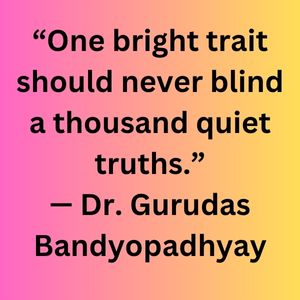
7 October 2025 GA
Core Insight: The mind loves shortcuts — but awareness loves truth.
Thought Spark
We’re often not seeing people — we’re seeing their halo.
When one shining quality — beauty, charm, intelligence, confidence — catches our eye, the brain floods everything else with that same glow.
That’s the Halo Effect: when one bright trait blinds us to what lies beyond it.
And it doesn’t just happen with others.
We do it to ourselves, too.
We glorify one talent and forget our flaws — or we fixate on one flaw and forget our strength.
That’s not self-awareness. That’s distortion.
True awareness begins when we pause and ask:
“Am I seeing the person — or just the glow around one part of them?”
Removing the halo doesn’t make you see less.
It helps you see completely.
Why It Matters
The Halo Effect seems harmless — but it can quietly:
Skew your decisions
Distort your relationships
Blind you to someone’s deeper truth
Limit how fairly you see yourself
We may trust someone too easily because they seem confident.
Or we may underestimate ourselves because one weakness overshadows ten strengths.
When one light blinds the rest — perception becomes a trap.
Real connection, real leadership, and real growth begin with clear sight — not glow.
Action Step
Next time you form a strong first impression — positive or negative — pause.
Ask yourself:
What are three things I don’t yet know about this person/situation?
What might I be overlooking beneath the surface?
If I remove the glow (or shadow), what remains?
This 10-second check breaks the illusion — and builds awareness.
Reflection Prompt
Where today did I let one impression define the whole picture — in judging others or myself?
What did I miss when I only saw the glow?
Micro-Lesson: How the Halo Effect Works
The brain seeks simplicity. It likes a clean, consistent story.
So if we notice one impressive quality — our brain fills in the blanks.
We assume that person is also kind, smart, trustworthy, good-hearted — based on a single trait.
It’s efficient — but it’s not accurate.
Awareness doesn’t strip life of beauty. It removes the blur so we can see truth clearly.
Example
Before awareness:
“He’s so confident — he must be a great leader.”
After awareness:
“He’s confident. But is he also kind? Fair? Accountable?”
That’s not cynicism — it’s clarity.
Quote (Dr. Gurudas)
“You don’t have to destroy the halo. You just have to see beyond it.”
— Dr. Gurudas Bandyopadhyay
Affirmations
“I see people beyond their glow — and myself beyond my flaw.”
“I choose awareness over assumption.”
“I allow the full picture to emerge — not just the easy one.”
“I release the habit of over-glorifying or over-judging — and come back to truth.”
Slogan
“Remove the halo. Reveal the human.”
💡 10 Ideas to Expand Awareness of the Halo Effect
1️⃣ Reverse the Lens Exercise
If you admire someone deeply, flip the script:
Ask: “What might I be missing or idealizing in them?”
This helps you spot blind admiration that might cloud judgment.
2️⃣ Un-glorify Titles and Status
The brain tends to assign positive traits to people with high status (e.g., doctors, CEOs, spiritual leaders).
Remind yourself:
“Position doesn’t equal purity. Let me observe their actions, not just their role.”
3️⃣ Audit Your First Impressions
At the end of each day, recall 1–2 people you formed an opinion about quickly.
Ask: “Was it based on one quality — or the whole person?”
This builds awareness over time.
4️⃣ Pause Praise Reflex
When you find yourself praising someone for being “amazing” — pause and define it:
“Amazing in what ways? Where might they still be growing?”
It helps you ground admiration in reality.
5️⃣ Watch Out for Self-Haloing
Sometimes we glorify a single success to avoid self-inquiry.
Ask: “Am I hiding behind one strength to avoid facing other growth areas?”
Self-awareness begins with this honesty.
6️⃣ Explore Media Bias
Celebrities and influencers are perfect examples of the Halo Effect.
Just because someone is attractive, funny, or well-spoken doesn’t mean they are ethical or trustworthy.
Try analyzing your reactions to public figures — and notice where glow is overpowering facts.
7️⃣ Use Character Journaling
Think of someone you admire deeply.
List:
3 qualities you know to be true
2 things you might be idealizing or assuming
This helps train balanced, conscious admiration.
8️⃣ Practice “Whole-Person Thinking”
Before making a judgment (positive or negative), complete this sentence:
“Yes, they are [trait], and they are also a full human with unseen stories.”
This sentence neutralizes bias with compassion.
9️⃣ Teach Kids (and Adults) About It
The Halo Effect often begins in childhood: “He’s handsome, so he must be nice.”
Help young people learn to separate surface impressions from true character.
This builds a generation of conscious perceivers.
🔟 Notice “Halo Triggers” in You
Each of us has personal halo triggers — qualities we admire so much that we overlook everything else (e.g., confidence, intelligence, appearance).
Identify yours and write:
“When I see ____, I tend to idealize. Let me stay grounded in full awareness.”
10-Day Awareness Journal: Seeing Beyond the Halo Effect
Purpose: To gently train the mind to notice and dissolve the Halo Effect — the bias that lets one positive trait color our full perception of someone (or ourselves).
Each day offers:
A daily theme
A reflection prompt
A practice activity
📅 Day 1: Awareness Begins 🪞 Prompt: Who did I admire quickly today? Why? ✅ Practice: Write down the exact quality you noticed. Then ask: What else do I not yet know about them?
📅 Day 2: Seeing People, Not Personas 🪞 Prompt: Is there someone I idealize too easily — a friend, leader, or public figure? ✅ Practice: List 3 strengths you admire — and 2 things you’ve never questioned or explored.
📅 Day 3: Mirror Check — Self-Halo 🪞 Prompt: Do I ever hide behind one strength to avoid looking at other parts of myself? ✅ Practice: Write down a strength you’re proud of. Then gently reflect: What’s one area I’ve avoided because of this glow?
📅 Day 4: Pausing the Praise Reflex 🪞 Prompt: Today, did I praise someone automatically? ✅ Practice: Recall what triggered your praise. Now ask: What do I assume about them — and what’s actually confirmed?
📅 Day 5: Status vs. Substance 🪞 Prompt: Did a person’s status or appearance affect how I judged them? ✅ Practice: Describe the situation. Then ask: Would I feel the same if their outer traits were different?
📅 Day 6: Language Audit 🪞 Prompt: What glowing labels did I use today — e.g., “amazing,” “brilliant,” “the best”? ✅ Practice: Break down what those labels actually mean in context. Are they based on fact or feeling?
📅 Day 7: The Whole Human View 🪞 Prompt: Choose one person. Complete the sentence: “They are [quality], and they are also…” ✅ Practice: Write 3 statements that remind you to see their full humanity, not just the glow.
📅 Day 8: Media & the Halo Trap 🪞 Prompt: Did I form a fast opinion today from social media, news, or appearance? ✅ Practice: Reflect on what impression formed — and why. Then list 2 unknowns behind the image.
📅 Day 9: Rewiring Respect 🪞 Prompt: How can I respect someone without idolizing them? ✅ Practice: Choose one admired person. List 3 strengths and 1 healthy limitation you’ve observed.
📅 Day 10: Freedom from the Glow 🪞 Prompt: What has the Halo Effect cost me in clarity, connection, or self-awareness? ✅ Practice: Write a short note to yourself: “From now on, I will seek to see clearly, not glowingly.”
Final Affirmation:
“I see others and myself as whole — not perfect, not flawed, but fully real.”
Both Halo and Horn effects are two sides of the same psychological coin — the distortion of perception through bias.
But while the Halo Effect paints others (or ourselves) with too much light, the Horn Effect does the opposite:
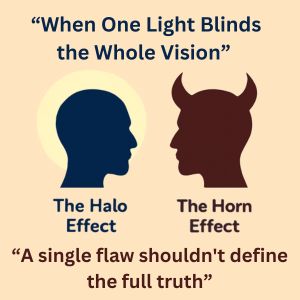
it clouds our judgment with a single dark shadow.
Let’s explore it clearly and calmly — from concept → real-life examples → self-observation → transformation.
Understanding the Horn Effect
“When one flaw defines the whole picture.”
The Horn Effect occurs when one negative trait, impression, or behavior dominates your overall perception of a person, event, or even yourself —
leading you to overlook positive qualities or possibilities.
It’s named after the symbolic “horns” of the devil — the opposite of the “halo” of goodness.
The Core Psychology
Our brains like simplicity.
They prefer quick, consistent stories over complex, balanced truths.
So when we see a single fault — rudeness, mistake, untidy appearance, failure, or dissent — we unconsciously label the whole person as less capable, less kind, or less trustworthy.
This is not deliberate; it’s cognitive efficiency.
But awareness demands we slow down enough to ask —
“Am I seeing the person, or just reacting to one event?”
Everyday Examples of the Horn Effect
In the Workplace:
You notice an employee arrive late once, and unconsciously tag them as “undisciplined.”
Later, you might overlook their creativity or dedication — because the label quietly sits in your mind.
In Relationships:
Someone snaps during stress, and we start seeing them as “irritable” or “negative.”
That single behavior overshadows months of kindness or reliability.
🪞 In Self-Perception:
You fail one task and start thinking, “I’m not good at this,” or “I’m not capable.”
That one incident becomes the lens through which you judge your entire ability.
This is the internal Horn Effect — the critic turning a moment into an identity.
The Deeper Impact
The Horn Effect quietly erodes empathy, objectivity, and self-trust.
It:
Limits how we see others (bias).
Shrinks how we see ourselves (self-doubt).
Damages how we make decisions (reactivity over reflection).
It turns observation into judgment, not understanding.
And that’s the exact opposite of noticing with awareness.
Awareness Practice — Breaking the Horn Effect
Here’s how to dissolve it gently in daily life:
1️⃣ Catch the Snap Judgment
Whenever you feel instant dislike or irritation, pause and name it:
“This is my Horn Effect showing.”
Naming the bias breaks its automatic grip.
2️⃣ Ask Three Balancing Questions
What do I not yet know about this person/situation?
What are at least two positive or neutral aspects I may be overlooking?
If someone judged me for one mistake, how would I want them to respond?
3️⃣ Observe Patterns
Notice when the Horn Effect appears most — under stress, fatigue, or when someone’s behavior touches your own insecurity.
That’s often where the real lesson lies.
4️⃣ Use Reflective Journaling
Each evening, write:
“Who or what did I judge quickly today?”
Then add one line:
“What truth might I have missed?”
This single question reopens perception.
🪞 Example of Shifting Awareness
Before awareness:
“She’s always careless — look, she made another mistake.”
After awareness:
“She’s been under pressure lately — maybe her focus slipped. Let me understand before I conclude.”
That’s not indulgence; it’s balanced perception.
In Essence
Effect Trigger Result Awareness Practice
Halo Effect Positive first impression Overestimation Ask: “Am I seeing only the glow?”
Horn Effect Negative first impression Underestimation Ask: “Am I seeing only the flaw?”
Both dissolve through the same antidote: Mindful Observation.
Today’s Spark on the Horn Effect
Title: “When One Shadow Covers the Whole Sky”
We often let one mistake, one fault, or one off moment decide how we see everything that follows.
That’s the Horn Effect — perception narrowed by a single shadow.
But awareness is sunlight: the moment we notice the shadow, it softens and truth returns.
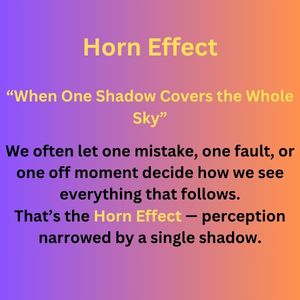
The art of seeing clearly begins with forgiving the first impression.
Read our Book – The 360° Leadership: Develop Effective Communication, Lead All Levels, Empower Teams, and Achieve Unparalleled Organizational Impact