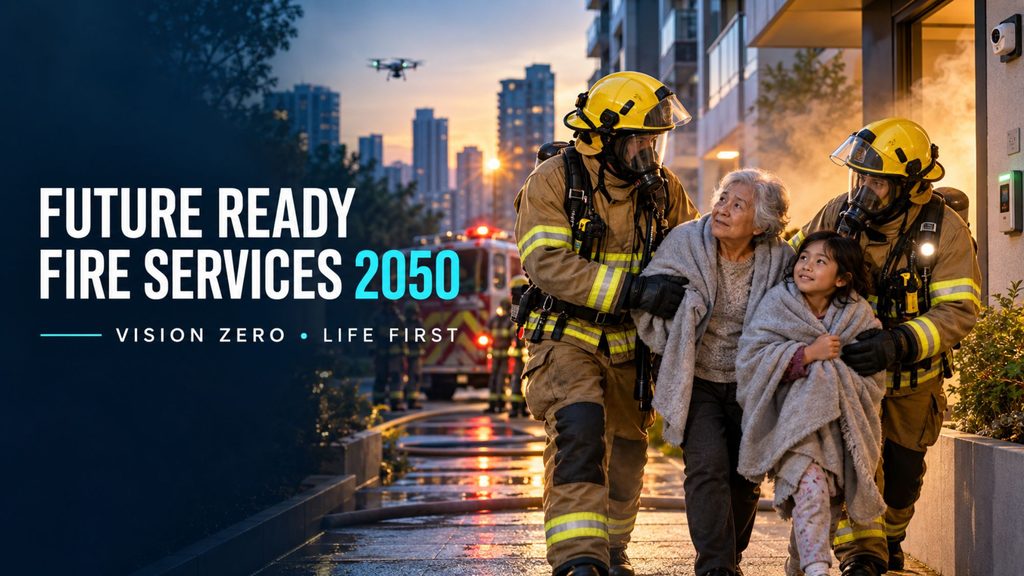
Future Ready Fire Services 2050: A Vision Zero Strategy for Saving Lives
How prevention, skilled people, better equipment and responsible AI can reshape fire and rescue
When a fire service is called, the public sees urgent work: engines arriving, firefighters entering danger, people being rescued and flames brought under control. Much of the work that saves lives, however, takes place earlier. It happens when an alarm is installed, an exit is kept clear, a building risk is identified or a family practices how to escape.
That is the starting point for a future ready fire service. Its mission is larger than fighting fire. It is to protect life before, during and after an emergency.
By 2050, fire services may face greater climate risks, more complex buildings, new energy systems and growing demands for rescue and medical response. They will also have better tools. The question is whether they can bring people, prevention, technology and public policy together around one ambitious goal: Vision Zero—no preventable loss of life from fire.
Fire services already do far more than fight fires
Responsibilities vary across countries and communities. In some places, firefighters provide ambulance services; in others, medical response belongs to a separate organisation. Some services lead flood rescue or wildfire operations, while others support specialist agencies.
Across the world, today’s fire services may work in prevention and inspections; structural, industrial, vehicle and landscape fires; road collision and technical rescue; emergency medical care; hazardous materials incidents; public education; disaster response; and recovery.
These are substantial responsibilities. In the United States, emergency medical services are the leading category of incidents reported by fire departments. Singapore’s Civil Defence Force recorded 257,158 emergency medical calls in 2025, alongside its fire response and safety enforcement work. The figures reflect those particular systems, but they illustrate how widely the mission has grown. (www.usfa.fema.gov)
Fire services are becoming essential partners in community resilience: helping people avoid danger, survive emergencies and recover from them.
What could change by 2050?
The future cannot be forecast precisely. Local conditions, resources and policy will determine what each service needs. Several present trends, however, make new demands likely.
Climate and landscape fires may require longer operations, wider cooperation and greater attention to smoke and evacuation. A United Nations Environment Programme report projects that extreme fires could increase globally by up to 30% by the end of 2050 because of climate and land use change. This is a global projection, not a prediction for every fire district. (www.unep.org)
New energy systems will require continuing learning. Electric vehicles, charging facilities, rooftop solar and battery energy storage bring benefits, but damaged batteries and electrical installations can create unfamiliar incident conditions. Responders need current site information, practical training and guidance that keeps pace with changing technology. (www.usfa.fema.gov)
Complex buildings and infrastructure may make access, search, evacuation and command harder. Tall buildings, underground spaces, mixed-use developments and ageing structures all demand preparation before an incident occurs.
Public expectations may also expand. Communities will need timely warnings, assistance for people who cannot evacuate unaided, and dependable response when several emergencies occur at once.
By 2050, the strongest fire services will have developed their capacity to prevent and prepare alongside their capacity to respond.
Vision Zero: Make every preventable death matter
Vision Zero is an aspiration to eliminate preventable deaths among members of the public and responders. It is not a promise that every outcome can be controlled. It is a commitment to examine each loss, identify avoidable risks and act on what has been learned.
A fire death may reveal several failures: an alarm that did not work, an escape route that could not be used, a building hazard that was not corrected, or information that did not reach responders in time. Looking only at what happened after the first engine arrived can miss opportunities to save the next life.
A Vision Zero service therefore asks four questions:
1. Who is at risk most?
2. What could prevent the emergency or provide an earlier warning?
3. What will help occupants and responders survive if it occurs?
4. What must change after every serious incident or near miss?
These questions connect fire prevention, building safety, public health, response and learning. They also make the goal measurable. A service can track working alarms, corrected building hazards, evacuation readiness, response capability, injuries and completed improvements—not just the number of fires attended.
Save life first—but coordinate every action
“Save life before firefighting” expresses the right priority. It should not be treated as a fixed order requiring crews always to search before applying water.
At some incidents, an immediate rescue is possible. At others, controlling the fire quickly can improve conditions for people inside and make rescue safer. Search, rescue, fire suppression and ventilation must be coordinated according to the conditions crews find. Fire Safety Research Institute experiments examine how the timing of these actions affects conditions for occupants and responders. (fsri.org)
The practical question for an incident commander is: “Which coordinated actions offer the best chance of protecting life now, while managing the risk to crews?” The answer can change as information and conditions change.
Just as important, life protection must begin before the incident. The U.S. Fire Administration warns that residents may have less than two minutes to escape a home fire after a smoke alarm sounds. That small window makes working alarms, usable exits and practised escape plans essential. (www.usfa.fema.gov)
Build the people who will deliver the vision
The future fire service needs sound judgment as much as new technology. Core skills in fire behaviour, search, rescue, medical response and incident command must remain strong. Training must also evolve to address batteries, complex buildings, hazardous materials, extreme weather and communication with diverse communities.
Short, repeated exercises based on local risks can be more useful than training that personnel rarely get to apply. Departments should bring firefighters, dispatchers, medical personnel and partner agencies into realistic scenarios, then use the results to improve procedures.
Recruitment should widen the range of skills available to a service. Technical specialists, educators, data analysts and experienced community volunteers can complement operational crews. Smaller departments may need to share specialist resources across boundaries.
Protecting personnel is part of Vision Zero. The International Agency for Research on Cancer classifies occupational exposure as a firefighter as carcinogenic to humans. Exposure reduction, equipment cleaning, health support and recovery after demanding incidents deserve routine attention. A service cannot sustain excellent public protection by wearing down its own workforce. (www.iarc.who.int)
Improve vehicles and equipment for local conditions
There is no single ideal fire engine for every place. A dense city, an industrial area, a remote village and a wildfire-prone district have different access routes, water supplies and incident patterns.
Fleet decisions should begin with a local risk assessment. A service may need conventional engines, smaller rapid-response vehicles, rescue appliances, water carriers, ambulances or specialist units. The right mix must also be maintainable: a vehicle that cannot be serviced or supplied with parts is of little help during an emergency.
The same applies to equipment. Reliable breathing apparatus, communications, protective clothing, water delivery, rescue tools and means of assessing conditions are fundamental. Drones, remote cameras and robots may help crews inspect dangerous areas, but they require trained operators and evidence that they improve decisions. NIST is researching how connected information can support fireground operations. (www.nist.gov)
Departments should budget for the entire working life of equipment: inspection, cleaning, calibration, repair, replacement and training.
Use generative AI as a capable assistant
Generative AI could help fire services draft multilingual education materials, create training scenarios, summarise incident lessons, organise technical guidance and prepare public messages for review. It may also help planners explore how different hazards could affect staffing and resources.
These uses are promising, but a convincing answer is not necessarily a correct one. An AI system can produce an outdated instruction, invent a building detail or overlook a vital exception. Sensitive information about patients, buildings and critical infrastructure also requires protection. NIST’s guidance identifies fabricated outputs and other risks that organisations need to manage when adopting generative AI. (www.nist.gov)
A responsible service would test an AI tool for a defined purpose, give it verified information, require human review where safety is at stake and retain a way to work when the tool is unavailable. The aim is to help people make better decisions while keeping responsibility clear.
Ten priorities to begin developing now
A 2050 vision becomes useful only when it changes today’s work. These ten priorities offer a starting agenda for fire service leaders and their partners:
Priority Action now
1. Know the local risk Map fires, injuries, near misses, vulnerable locations and barriers to escape. Review the picture regularly as the community changes.
2. Reach people before an emergency Target working smoke alarms, home safety visits and practised escape plans where risk is greatest.
3. Improve building safety Work with owners and authorities to correct serious hazards, maintain protection systems, keep exits usable and provide responders with current building information.
4. Plan for assisted evacuation Develop arrangements with older adults, people with disabilities, carers, schools and care facilities. Test whether warnings and evacuation plans work in practice.
5. Train for coordinated life-saving operations Exercise assessment, command, search, rescue, suppression, ventilation and medical care as connected actions.
6. Strengthen dispatch and communications Get reliable information to crews promptly, support communication between agencies and maintain backup procedures for system failures.
7. Protect responder health Improve staffing, protective equipment, exposure reduction, rehabilitation and access to physical and psychological care.
8. Prepare for emerging hazards Update plans and training for batteries, complex buildings, industrial change and climate-related incidents.
9. Learn and act after incidents Review deaths, injuries, rescues and near misses. Assign each improvement an owner and check that it was completed.
10. Make Vision Zero a shared commitment Agree on responsibilities with government, health services, building owners and communities. Publish progress in prevention and response.
An often overlooked need runs through all ten: public trust. Warnings must be understandable and usable by people with different languages, abilities and access to technology. Early warning succeeds only when people can take action on it. (www.undrr.org)
The measure of a future ready service
Firefighters will always need the skill and courage to act when danger is immediate. Future readiness does not diminish that work. It supports it with better buildings, informed residents, prepared crews, dependable equipment and decisions grounded in evidence.
The fire service of 2050 should be able to answer not only, “How effectively did we fight the fire?” but also, “How many people were safe because we acted before it began?”
The finest fire service of the future will be known both for the lives it rescues and for the lives its preparation never allows to be endangered.
— Dr. Gurudas Bandyopadhyay