Daily Spark #34: Emotional Agility — Dancing with Life’s Uncertainties
Date: 30 August2025, Atlanta
Theme Title
Emotional Agility: Dancing with Life’s Uncertainties
Keyword of the Day
Agility
Thought Spark
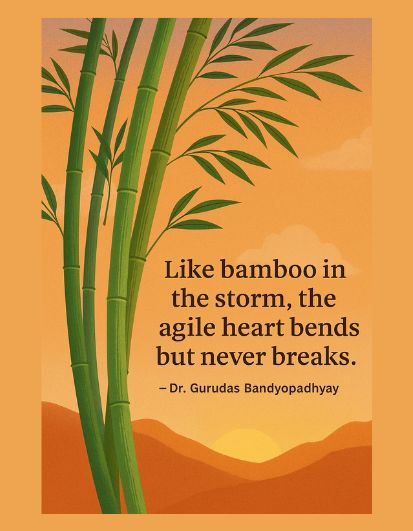
Life doesn’t ask us to control every emotion — it asks us to flow with them. Emotional agility is the art of acknowledging feelings without being trapped by them. Instead of suppressing sadness, resisting anger, or chasing only happiness, we learn to dance with uncertainty. Just like bamboo bends in a storm but never breaks, emotionally agile people bend with life yet stay rooted in purpose.
Quote by Dr. Gurudas Bandyopadhyay
“Emotional agility is not about silencing emotions, but listening to them without losing your balance.”
Slogan
“I honor my emotions, but I am not enslaved by them.”
Affirmations on Emotional Agility
“I honor every emotion as a messenger, not my master.”
“Flexibility makes me stronger than resistance.”
“I can bend with life’s uncertainties without breaking.”
“My emotions guide me, but they do not define me.”
“Each feeling is a teacher—I am ready to learn.”
“I stay calm, centered, and open in the storm of change.”
“I dance with my emotions instead of fighting them.”
Mini Action Step
Today, name one difficult emotion you’re feeling. Instead of suppressing it, write down what it might be teaching you.
Why Emotional Agility Matters
Builds resilience during crises.
Strengthens relationships through empathy.
Fuels creativity by opening space for vulnerability.
Improves mental clarity by reducing emotional clutter.
Makes us adaptable in careers and family life.
Expert Insights
Susan David (Harvard psychologist): coined the term “Emotional Agility” — flexible people thrive where rigid ones break.
Daniel Goleman (Emotional Intelligence): emotions are data, not directives.
Mindfulness research: Naming emotions (“I feel anxious”) calms the brain’s amygdala.
7 Key Takeaways
Emotions are messengers, not masters.
Suppression leads to stress; agility leads to growth.
Emotional labeling creates inner calm.
Flexibility prevents burnout.
Vulnerability strengthens human connection.
Agility makes problem-solving sharper.
Life’s uncertainties become opportunities, not threats.
Action Steps
Pause before reacting to strong emotions.
Label the feeling in one word (“anger,” “joy,” “fear”).
Ask: “What is this emotion trying to teach me?”
Breathe deeply for 2 minutes before deciding next step.
Share honestly with someone you trust.
Write in a journal about one difficult emotion today.
Reframe the feeling: “Instead of fear, this is my courage warming up.”
Read my Book – Enjoy Living Each Day https://relinks.me/B09CKJ7CGL
Reflection
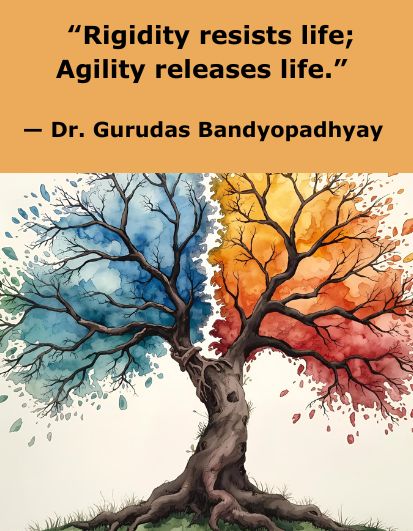
Rigid trees snap in the storm, but flexible bamboo survives. Similarly, when we stop resisting emotions and instead let them guide us, we grow stronger and freer. Emotional agility is not about avoiding uncertainty—it’s about dancing with it gracefully.
Reflection Questions
Which emotions do I resist most often?
How do I typically react when life throws surprises?
What would change if I viewed emotions as teachers, not enemies?
Can I stay flexible in a difficult conversation today?
Bonus: 10 Micro-Ideas for Emotional Agility
Journal prompt: “What emotion visited me most this week?”
Affirmation: “I ride the waves of emotion without drowning.”
Mini-practice: Write a letter to your anger, then tear it.
Visualization: Imagine emotions as clouds drifting across your sky.
Story seed: Mandela’s patience in prison = emotional agility.
Work angle: Handling workplace criticism with calm.
Relationship angle: Pausing before reacting in family conflicts.
Analogy idea: “Emotion Compass” infographic.
Quick habit: Each night, note one emotion and its hidden gift.
Book tie-in: Connect to Atomic Thoughts (tiny emotions shift big outcomes).