
Beyond Well-Being: How Thriving Adults Can Improve Their Quality of Life
Measure What Matters. Strengthen What Is Weak. Enrich What Is Possible.
Learn from globally validated measures—and go further toward growth, purpose and contribution.
A person may be physically healthy but deeply lonely. Another may be financially comfortable yet chronically anxious. Someone may remain extremely busy and productive but feel that life lacks meaning. Conversely, a person living with health limitations may experience love, purpose, dignity and genuine satisfaction.
These differences remind us that quality of life is much broader than health, wealth, comfort or achievement alone. It reflects how well the different dimensions of our lives work together—and how we personally experience our circumstances.
Improving quality of life does not require us to pursue perfection. It requires us to understand what matters, recognize what is missing and make thoughtful improvements. Scientifically validated quality-of-life instruments can help us identify the essential foundations. We can then go further by cultivating vitality, personal growth, meaningful engagement and contribution.
What Does Quality of Life Really Mean?
Quality of life, commonly abbreviated as QoL, refers to a person’s perception of life in relation to physical health, psychological state, relationships, independence, environment, values, aspirations and concerns.
Several related concepts should be distinguished:
• Standard of living concerns income, housing, possessions and material comfort.
• Health-related quality of life focuses on how health affects functioning and daily living.
• Life satisfaction reflects how positively people evaluate their lives as a whole.
• Subjective well-being includes positive emotions, life satisfaction and the relative absence of severe distress.
• Flourishing means functioning well, developing one’s potential, maintaining meaningful relationships and contributing purposefully.
Quality of life contains both objective conditions and subjective experiences.
Objective conditions include health, income, housing, safety, mobility and access to essential services. Subjective experiences include happiness, peace, belonging, autonomy, fulfilment and meaning.
Two people living under similar conditions may therefore assess their lives very differently. Personal values, expectations, health, relationships, culture and stage of life all influence the experience of QoL.
What Established QoL Instruments Teach Us
Several respected instruments are used internationally in healthcare, research and public-health programmes.
The WHOQOL-BREF, developed through the World Health Organization, examines four broad domains:
1. Physical health
2. Psychological well-being
3. Social relationships
4. Environment
The WHOQOL-OLD, designed particularly for older adults, draws attention to autonomy, sensory abilities, social participation, intimacy, meaningful activities and attitudes toward ageing and mortality.
The EQ-5D-5L concentrates on five health-related areas: mobility, self-care, usual activities, pain or discomfort, and anxiety or depression.
The PROMIS Global Health measures physical, mental and social health, including functioning, fatigue, pain and overall quality of life.
The CDC Healthy Days measures examine perceived physical and mental health and the number of days during which poor health limits normal activity.
These instruments differ in purpose and scope, but together they teach us an important lesson: quality of life is multidimensional. Ignoring one seriously weakened dimension may eventually affect many others.
Formal instruments should be administered and scored according to their official instructions. Their copyright, translation and licensing requirements must also be respected. Nevertheless, the domains they assess can help every adult understand the foundations of a better life.
Seven Foundations of a High-Quality Life
1. Physical health and vitality
Physical well-being includes more than freedom from diagnosed disease. It involves energy, mobility, strength, sleep, nutrition, pain management and the ability to perform everyday activities.
Thriving adults care for their bodies before a crisis compels them to do so. They remain physically active within their capacity, eat thoughtfully, sleep adequately, use medicines responsibly and seek timely medical care.
The goal is not to possess a perfect body. It is to develop the best possible functioning and vitality within one’s circumstances.
2. Mental and emotional well-being
A good life does not require uninterrupted happiness. Fear, disappointment, grief and frustration are normal human experiences. Emotional well-being means recognizing these feelings, responding constructively and recovering without allowing distress to dominate life indefinitely.
Self-awareness, emotional regulation, hope, gratitude, resilience and healthy self-talk strengthen psychological well-being. When sadness, anxiety, sleeplessness or emotional distress becomes persistent or disabling, professional assistance may be necessary.
Seeking help is not weakness; it is responsible self-care.
3. Meaningful relationships and belonging
People need more than social contact. They need to feel seen, respected, understood and valued.
Supportive family relationships, trusted friendships, intimacy and community participation protect against isolation. Meaningful relationships require attention, listening, appreciation, forgiveness and reciprocity.
The number of contacts stored in a telephone cannot measure the quality of human connection. One dependable relationship may enrich life more than hundreds of superficial interactions.
4. Autonomy, dignity and responsible choice
Autonomy is the ability to make meaningful decisions about one’s life. It includes control over daily routines, personal boundaries, activities, finances and future direction.
Ageing, illness or disability may reduce independence in certain areas, but assistance should not unnecessarily remove a person’s dignity or voice.
Healthy autonomy does not mean rejecting help. It means participating in decisions and accepting appropriate support without surrendering one’s identity. Mature autonomy gradually develops into wise interdependence—the ability both to receive and to provide support.
5. Safety and a supportive environment
Quality of life is difficult to sustain in unsafe, polluted, chaotic or inaccessible surroundings.
A supportive environment includes:
• Physical and psychological safety
• Suitable housing
• Clean air and water
• Access to healthcare, information and transportation
• Protection from violence, abuse, fraud and discrimination
• Opportunities for recreation and contact with nature
• Responsible use of technology
Safety is not merely the absence of accidents. It is the presence of conditions that allow people to live, work, travel and grow with reasonable confidence.
6. Financial sufficiency and time well-being
Money cannot guarantee happiness, but financial insecurity can damage health, relationships, dignity and peace of mind.
Financial well-being means being able to meet essential needs, manage resources responsibly, prepare for foreseeable demands and avoid unnecessary debt or impulsive consumption. It does not necessarily mean possessing great wealth.
Time is another vital resource. A person may be financially prosperous but time-poor—always rushing, working or responding to others. A high-quality life requires sufficient time for sleep, relationships, reflection, recreation, learning and meaningful priorities.
Prosperity should therefore include both financial security and time freedom.
7. Purpose, growth and contribution
People do not flourish through comfort alone. They also need reasons to awaken with interest and move forward with hope.
Purpose may arise from family, work, learning, creativity, faith, mentoring, service or community involvement. It need not be grand or publicly recognized. A meaningful purpose is one that gives direction to daily effort and connects personal abilities with something valuable.
Continued learning keeps the mind active. Contribution turns knowledge and experience into social value. At every age, people can teach, encourage, guide, create, protect, volunteer or share what they have learned.
Protect the Foundations Before Pursuing Higher Performance
Thriving should not be confused with constant productivity.
Before pursuing ambitious goals, we must recognize conditions that require care:
• Persistent illness or pain
• Sleep deprivation
• Depression or severe anxiety
• Unsafe living or working conditions
• Social isolation
• Financial crisis
• Loss of functional independence
• Excessive occupational or caregiving pressure
Positive thinking cannot replace medical treatment, rehabilitation, counselling, adequate rest or practical assistance. Motivation may help us act, but it cannot by itself repair every weakened foundation.
Sometimes the most productive action is to pause, recover and seek support.
Moving Beyond Basic Well-Being to Thriving
Once essential foundations are reasonably secure, adults can intentionally enrich their lives.
Move from functioning to vitality
Do not aim merely to avoid illness. Develop strength, balance, flexibility, energy and habits that support healthy longevity.
Move from emotional stability to emotional richness
Go beyond controlling negative emotions. Cultivate gratitude, wonder, humour, hope, compassion and the ability to savour good experiences.
Move from social contact to deep connection
Do not merely remain surrounded by people. Build relationships characterized by trust, understanding, affection and mutual support.
Move from busyness to meaningful engagement
Examine whether daily activities reflect genuine priorities. Reduce low-value commitments and devote more attention to work that expresses your values and strengths.
Move from consumption to creation
Reading, watching and purchasing may bring temporary pleasure. Writing, teaching, building, gardening, mentoring and solving problems create deeper engagement.
Move from personal achievement to contribution
Achievement asks, “What have I accomplished?” Contribution asks, “Whose life has become better because I acted?”
A thriving life accommodates both.
Use PDCA to Improve Quality of Life
Quality of life cannot be improved effectively through vague wishes. The Plan–Do–Check–Act cycle, widely used for continual improvement, can be adapted for personal life.
Plan
Identify the QoL area that currently requires the most attention. Decide on one realistic action.
Instead of writing, “I must improve my health,” plan something observable:
“I will walk for 25 minutes after breakfast.”
Do
Carry out the planned action. Start small enough to remain consistent. Record what actually happened without exaggeration or self-condemnation.
Check
Examine the result. Did the action help? What supported it? What interfered? How did it affect energy, mood, relationships or productivity?
Checking is not judging. It is learning from evidence.
Act
Continue what works, modify what is impractical and obtain help when the challenge exceeds your current ability. Then begin the next cycle.
Small PDCA cycles convert everyday life into a process of conscious learning and gradual improvement.
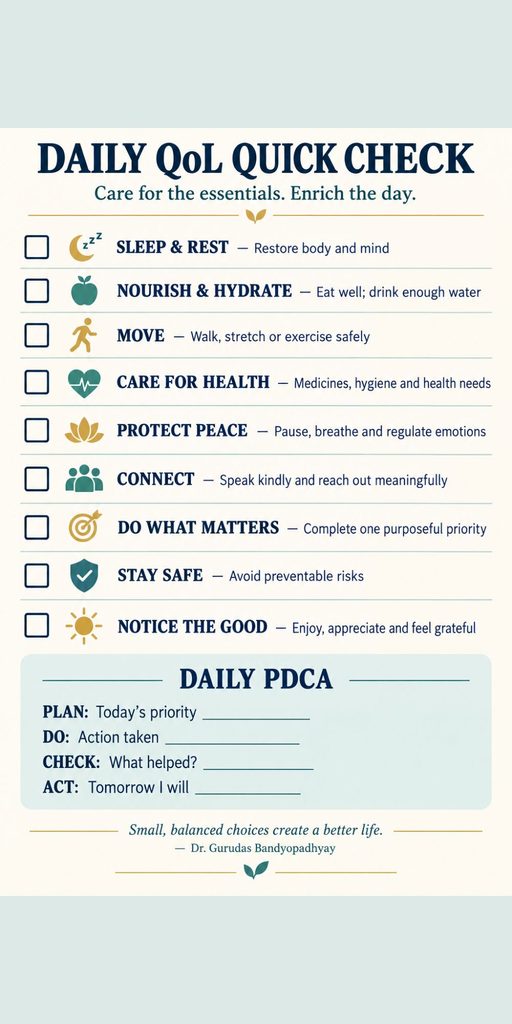
Daily QoL Journal Using PDCA
The following prompts can be completed in approximately five to ten minutes.
PLAN — My intention for today
1. What is the most important QoL dimension requiring my attention today?
2. What one specific action will I take?
3. When and where will I take it?
4. What difficulty could interfere?
5. How will I respond if that difficulty arises?
6. Who or what support may help me?
Today’s QoL action: ______________________________
DO — What I actually did
1. Did I complete the planned action fully, partly or not yet?
2. What other positive action did I take for my health, peace, relationships or purpose?
3. Did I make a meaningful connection with someone?
4. Did I learn, create, help or contribute?
5. What unexpected event influenced my day?
My action taken: _________________________________
CHECK — What I learned
1. How did today’s action affect my body, mood or energy?
2. What enriched my quality of life today?
3. What reduced it?
4. Which decision or habit served me well?
5. Where did I experience imbalance, avoidable stress or wasted time?
6. What am I grateful for today?
7. What does today’s experience teach me?
My most important learning: ________________________
ACT — My improvement for tomorrow
1. What should I continue?
2. What should I modify?
3. What should I stop or reduce?
4. What should I begin?
5. Do I need assistance, information or professional guidance?
6. What will be my one practical QoL action tomorrow?
Tomorrow’s improvement: __________________________
A Weekly Quality-of-Life Review
At the end of each week, rate the following areas from 1 to 10:
Quality-of-life dimension Rating
Physical health and vitality /10
Mental and emotional well-being /10
Relationships and belonging /10
Autonomy and dignity /10
Safety and environment /10
Financial and time well-being /10
Purpose, growth and contribution /10
Then reflect:
• Which dimension supported me most strongly?
• Which dimension quietly weakened my week?
• Is the difficulty temporary, repeated or worsening?
• What is within my control?
• What support do I need?
• What single improvement will receive priority next week?
This weekly rating is a personal reflection exercise, not a scientifically validated or diagnostic score. Its purpose is to reveal patterns and encourage action.
Do Not Allow Measurement to Become Self-Judgment
Quality-of-life measurement should increase awareness, not create guilt.
A low rating does not mean that a person has failed. It may reveal illness, grief, caregiving responsibilities, financial pressure, environmental barriers or other circumstances requiring understanding and support.
Nor should we expect every dimension to remain equally strong at all times. Life moves through changing seasons. During one period, recovery may deserve priority. At another, relationships, learning or purposeful work may take the lead.
The objective is not a perfect score. It is timely awareness, responsible action and continuing adjustment.
Build a Life That Is Both Livable and Worth Living
A high-quality life develops through three progressive levels:
1. Foundation: health, safety, stability and everyday functioning
2. Enrichment: relationships, autonomy, learning, recreation and joy
3. Elevation: purpose, contribution and legacy
Validated QoL instruments teach us what deserves attention. Personal reflection helps us understand our particular needs. PDCA transforms that understanding into sustained improvement.
Choose one dimension that presently needs care. Plan one manageable action, carry it out, examine its effects and improve the next attempt. Repeat the process patiently.
A better life is rarely created by one dramatic decision. It is built through small, balanced and meaningful choices made consistently.
“Quality of life begins with meeting essential needs, grows through balance and meaningful relationships, and reaches its highest expression when personal well-being becomes purposeful contribution.”
— Dr. Gurudas Bandyopadhyay
Author’s Note
The reflections and self-ratings in this article are intended for personal awareness and development. They are not substitutes for standardized assessment, medical diagnosis, psychological evaluation or professional treatment. Anyone experiencing persistent physical pain, emotional distress, functional decline or thoughts of self-harm should seek qualified professional assistance promptly.