The 5.0 Awakening: Why the Future of Technology is Reclaiming the Human Spirit
We live in an age of architectural wonders built entirely of data. For the past two decades, our global narrative has been dominated by words prefixed with “smart”—smart factories, smart phones, smart cities, and hyper-efficient algorithms. We were told that the ultimate goal of human advancement was absolute connectivity, total automation, and the flawless execution of digital data.
But a quiet, profound course correction is underway across the world.
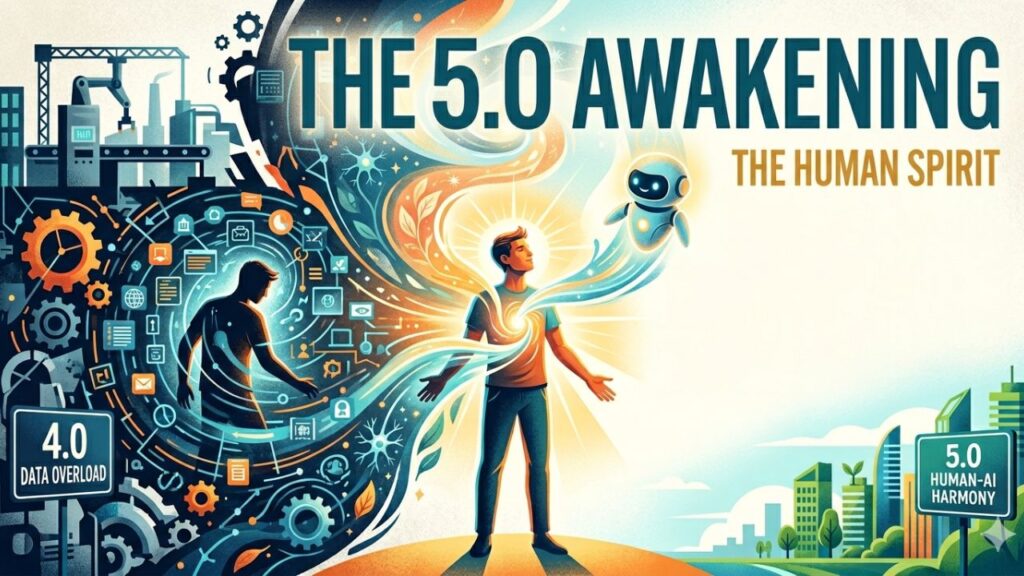
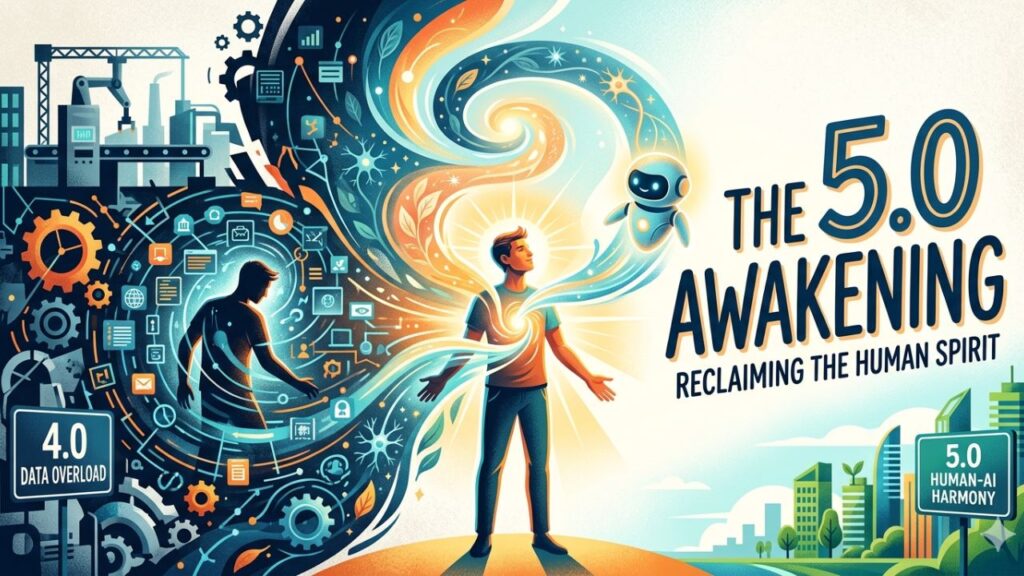
From global industrial manufacturing and urban planning to public health and personal development, a new framework is emerging. It is called Generation 5.0, and it carries a vital message for humanity: Technology has reached its peak of efficiency, but efficiency without empathy is hollow. The ultimate operating system is not silicon—it is human consciousness.
The Industrial Evolution: From 4.0 to 5.0
To understand where we are going, we must look at where we have just been. The era of Industry 4.0 was defined by the complete digitization of the physical world. It gave us the Internet of Things (IoT), cloud computing, and big data. Factories became autonomous entities where machines talked to machines.
Yet, hyper-optimization reached a point of diminishing returns. Stripping the human element out of production lines led to rigid, fragile systems that couldn’t adapt to unexpected global disruptions.
Enter Industry 5.0. Formalized by global policymakers, this new era shifts the spotlight away from the machine and back to the symbiosis between humans and robots. It realizes that robots possess speed and precision, but they entirely lack critical thinking, ethical judgment, and creative nuance. Industry 5.0 is anchored by three core pillars:
• Human-Centricity: Designing technology to serve the worker’s well-being and cognitive safety, rather than forcing the worker to adapt to the machine.
• Sustainability: Moving away from a purely profit-driven model toward a circular economy that respects planetary boundaries.
• Resilience: Creating flexible, agile systems led by multi-skilled humans capable of navigating unexpected global crises.
A Universal Paradigm Shift
This transition from the “.0” of data to the “.0” of human purpose is not confined to factory floors. It is a universal shorthand tracing across the entire fabric of modern society:
1. Society 5.0 (The Super-Smart Society)
First conceptualized in Japan, this model charts human history from the Hunter-Gatherer era (1.0), through the Agrarian (2.0), Industrial (3.0), and Information (4.0) ages. Society 5.0 integrates AI and big data not to track citizens, but to solve real-world human crises: caring for aging populations, predicting ecological tipping points, and ensuring equitable resource distribution.
2. Education 5.0 (Human-AI Co-Creation)
For generations, education focused on rote memorization (1.0) or digital retrieval (2.0 & 3.0). Education 4.0 raced to teach students how to code. But in the era of advanced AI, coding is automated. Education 5.0 resets the curriculum to grade and elevate what machines completely lack: Human Consciousness, ethical imagination, and deep emotional intelligence.
3. Vision Zero (Traffic Safety 1.0 to 4.0)
What began as an ethical shift to stop traffic deaths by altering road design (1.0 & 2.0) has evolved into a predictive ecosystem. Today, Vision Zero 3.0 and 4.0 utilize predictive AI and autonomous vehicle communication to build an accident-free world—proving that spaces can be engineered to safeguard human fragility.
4. Health 5.0 (Holistic Well-being)
Public health has evolved from basic sanitation (1.0) and acute medicine (2.0) to chronic care (3.0) and electronic records (4.0). Health 5.0 uses advanced diagnostics to shift medicine from “sick care” to preventative, predictive, and deeply personalized wellness, focusing heavily on mental freedom, stress reduction, and cognitive health.
The Personal Frontier: Cognitive Minimalism
Perhaps the most vital application of this generational shift is happening within our own minds. In the realm of personal development, we are witnessing a mass rejection of “Personal Development 3.0″—the exhausting trend of hyper-optimizing every minute of our lives with wearable trackers, sleep scores, and digital notifications.
This hyper-tracking has led to a modern epidemic of information overload and attention fragmentation.
The remedy is Personal Development 4.0 and 5.0, which champions Cognitive Minimalism. It is the intentional practice of clearing away digital noise, shedding the non-essential, and reclaiming our internal stillness. It recognizes that true personal growth is not about doing more things through the brute force of willpower; it is about cultivating the psychological flexibility to do the right things with deep, uninterrupted focus.
The Common Thread: Reclaiming Consciousness
When we look at the grand tapestry of these technological iterations, a beautifully consistent pattern emerges:
Generation / Wave Core Characteristic The Human Experience
Versions 1.0 – 3.0 Mechanical & Early Digital Muscle power gives way to automation; basic tracking begins.
Version 4.0 Hyper-Connectivity & Data The machine rules the network; information overload peaks.
Version 5.0+ Human-Centric Harmonization Technology is humbled; human consciousness returns to the center.
Artificial Intelligence can scan history, analyze billions of variables, and generate statistical averages in milliseconds. But AI operates strictly in the rearview mirror of existing data. It does not possess a soul, it does not understand context, and it cannot experience the quiet flash of intuitive genius.
Only Human Consciousness can look at a problem, inject meaning, apply ethical empathy, and innovate a completely unimagined future.
The 5.0 awakening is an invitation to every writer, thinker, leader, and everyday citizen. It tells us that as our tools become more complex, our minds must become more simple, anchored, and purposeful. The future does not belong to the machines that calculate—it belongs to the conscious humans who guide them.