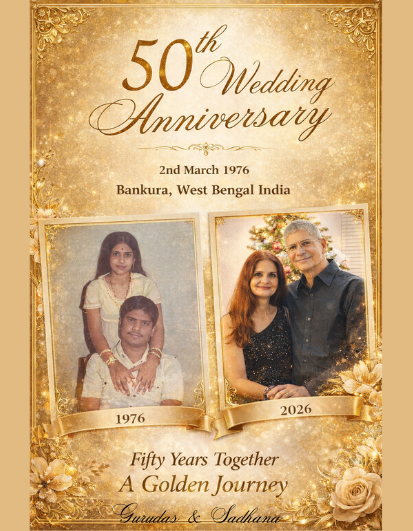
On 2nd March 1976, when I got married, electricity had just reached our home. In fact, one of our priorities before the wedding was to contact officials of the West Bengal State Electricity Board to ensure supply. That small detail says much about the India we were living in.
I was a young science graduate then, barely two years into service in a paramilitary force. We shifted to Barauni in Bihar soon after marriage. We were fortunate to get housing in Township. We had modest means, limited exposure, but strong family backing.
It was an arranged marriage. Elders guided it. We trusted their wisdom. That trust became the foundation of everything that followed. I saw my wife first time on Subha Dristi ceremony during marriage.
Looking back after fifty years, I realize our marriage did not just shape two individuals. It shaped a family system, and in a small way, contributed to society.
Stability Creates Family Wellness
Family wellness does not begin with wealth. It begins with stability.
In our early years, on changing jobs, transfers took us from Barauni to Ranchi to Bokaro. Company housing complexes became our small ecosystems. Children grew up among other families, shared playgrounds, and modest facilities. There was safety. There was community.
Soon our family grew to four children. Parenting responsibility was enormous. My wife Sadhana carried the greater burden in those years. Her quiet discipline and emotional strength kept the household steady while I focused on professional growth. We remain deeply grateful to her contribution.
Wellness in a family is often invisible. It is routine. It is regular meals. It is supervision of homework. It is emotional reassurance during exams. It is presence.
Education as a Social Elevator
One principle guided us clearly: education would be the primary investment.
We ensured all four children studied in English-medium schools and later technical colleges. They could speak Bengali but could not learn to write it. Even our letters to them in college hostels used to be written in English. That decision reflected a social transition taking place in India — the shift toward global competitiveness.
When they reached higher secondary level, I made a difficult decision. I changed my job and joined HPL in Haldia, sacrificing career momentum in the British Multinational Company, ICI; so that children could receive better education near Kolkata Metro city. Company housing in HPL HREL township and proximity to Haldia Engineering College proved to be blessings.
I took substantial bank loans — far beyond my comfort. Repayment took years. But I have never regretted that decision. Investment in education is long-term social capital. I used to think of the present more than future.
All four children completed technical degrees, pursued post-graduation, and later MBA specializations and so on. They built their own careers and families. One daughter earned a Ph.D. from IIT Kharagpur. For me, that was among the greatest milestones of my life.
When children surpass parents educationally, society progresses.
Self-Development Within Marriage
Marriage did not restrict my learning. It strengthened it.
When I married, I was only a science graduate. Over the decades, while managing family responsibilities, I completed:
MA in Economics, as I was always interested in Financial matters.
M.Sc. in Ecology & Environment, on service needs
MIFE (UK equivalent to BE) IFE, Leicester, UK, on service needs
MBA in Health Care management & Marketing Management
PGDBA – 2 years Post Graduate course from IIT Kharagpur, Vinod Gupta Scool of Management, with Human Resource Management
Ph.D. from IIT Kharagpur, the most coveted degree.
Continuous learning enhanced my career mobility. I moved from paramilitary service to public sector, later to industry including HSE Advisor in L&T, and eventually to the education sector in Bangalore. I did not like to continue job during Covid time and left as Director, P.G. Studies from SSRC, Bangalore. But that did not stop me, online teaching and writing books continued. All these were possible due to support from family.
Personal growth within family structure created a powerful message for our children: learning never stops.
Family wellness improves when parents continue to grow intellectually.
Migration and Adaptability
Our journey reflects India’s economic transformation, from 1950 onwards…
From Hyderabad to Kolkata to Barauni, Bihar to Nagpur, Delhi, to Ranchi, Jharkhand to Gomia, Bokaro, the then Bihar; to Haldia, West Bengal to Kolkata, to Bangalore, and later frequent visits to USA and Canada to see our children — we adapted repeatedly. We travelled across India and abroad: Thailand, Bhutan, more than a dozen European countries, the UK, USA, Canada and others.
Migration tested us but strengthened resilience. Company townships once defined our community life. Later, global mobility defined our children’s world.
Family wellness today requires adaptability across cultures and geographies.
Changing Social Landscape
In 1976, electricity was new in our home. Letters were handwritten. Career options were limited. Social respect came from stability and integrity. Communication was mainly based on postal services.
Today, technology dominates communication. Children work across continents. Opportunities are global.
But some truths remain constant:
Stability matters.
Education transforms.
Parental sacrifice shapes generational mobility.
Gratitude sustains relationships.
Modern society speaks often of success. But success without family grounding creates fragility.
Gratitude and Impermanence
Our parents and elders are no longer with us. But their blessings are always with us and showing right direction to go ahead.
My maternal grandfather played a decisive role in arranging our marriage. His conviction shaped our destiny.
No one is immortal. That is life.
But values transmitted by elders remain long after they depart. Gratitude creates emotional continuity between generations.
The River of Life
After children built their own families, our role changed again. From active parenting to supportive presence. From decision-makers to advisors.
The last decade has been divided between Bangalore and visits to our children abroad. After leaving formal service, I began my journey as an author. Life did not stop at retirement; it simply changed direction.
When I reflect on fifty years, I see life as a river. It does not flow in a straight line. It turns, slows, accelerates, widens, narrows. But it moves forward.
Family wellness, I have learned, is not a static state. It is sustained movement — guided by commitment, supported by education, strengthened by sacrifice, and softened by gratitude.
Fifty years ago, electricity had just arrived in our home. Today, our family spans continents.
The journey continues.
Lessons from Fifty Years: What Readers May Take Away
This journey is not important because it is mine. It is important only if it offers something useful to others. Looking back, a few lessons stand out.
1. Stability Is More Powerful Than Speed
Progress does not require dramatic beginnings. When we married, electricity had just arrived in our home. Resources were limited. But stability, not speed, created long-term growth.
In family life and in society, steady commitment often achieves more than quick success.
2. Marriage Is a Partnership in Growth
Marriage should not stop personal development. It should strengthen it.
Continuous learning, career shifts, higher education, and intellectual growth were possible because there was mutual support at home. When one grows, the family grows.
3. Education Is the Strongest Social Investment
Money spent on education is not an expense; it is generational capital.
Taking loans for children’s education felt risky at the time. But education created independence, dignity, and global mobility for the next generation. Society progresses when families prioritise learning.
4. Parental Sacrifice Has Long-Term Returns
Children may not fully understand sacrifices when they are young. But over time, values become visible.
Consistency, discipline, and emotional presence shape children more than luxury.
5. Adaptability Is Essential in a Changing World
Transfers, job changes, relocation for children’s education — none were easy. But flexibility allowed continuity.
Families that adapt without losing their core values remain strong even in rapidly changing societies.
6. Elders Matter
Arranged marriage was not a blind tradition. It involved wisdom, community judgment, and long-term thinking.
Respecting elders does not mean surrendering independence. It means recognising intergenerational continuity. Society weakens when it disconnects from its elders.
7. Success Is Broader Than Career
Degrees, promotions, international travel — these are milestones. But real success is when children become responsible, ethical, and self-reliant.
A peaceful family is a greater achievement than a prestigious designation.
8. Gratitude Sustains Mental Wellness
Life brings loss. Parents pass away. Children move out. Roles change.
Gratitude prevents bitterness. It allows us to see continuity instead of absence. Emotional maturity is essential for both family wellness and social harmony.
9. Life Moves Like a River
There is no final destination called “perfect stability.” There are phases.
Student. Professional. Parent. Mentor. Retiree. Writer.
Each stage demands adjustment. Acceptance of change is wisdom.
10. Strong Families Strengthen Society
Family wellness is not a private luxury. It contributes to social stability.
Emotionally secure individuals become responsible citizens. Long-term relationships reduce loneliness and fragmentation.
A healthy society is built quietly inside healthy homes.
If these reflections encourage even one family to invest in stability, education, gratitude, and mutual respect, then this fifty-year journey has meaning beyond itself.
“পাঠকের জন্য শিক্ষণীয় বিষয়” অংশটি বাংলায় লিখে দিলাম।
পঞ্চাশ বছরের পথচলা থেকে কিছু শিক্ষা
এই জীবনকথা গুরুত্বপূর্ণ নয় শুধু এই কারণে যে এটি আমার। গুরুত্বপূর্ণ তখনই, যদি এর ভেতর থেকে অন্য কেউ কিছু গ্রহণ করতে পারেন। পেছনে ফিরে তাকালে কয়েকটি শিক্ষা স্পষ্ট হয়ে ওঠে।
১. দ্রুত নয়, স্থিতিশীল অগ্রগতি বেশি শক্তিশালী
আমাদের বিয়ের সময় বাড়িতে সদ্য বিদ্যুৎ এসেছে। সম্পদ সীমিত ছিল। তবু স্থিরতা ছিল।
জীবনে ও পরিবারে দীর্ঘমেয়াদি স্থিতিশীলতা দ্রুত সাফল্যের চেয়ে বেশি ফলদায়ক।
২. দাম্পত্য জীবন ব্যক্তিগত বিকাশকে থামায় না
বিয়ে মানে স্থবিরতা নয়।
পারস্পরিক সহযোগিতা থাকলে উচ্চশিক্ষা, পেশাগত পরিবর্তন, আত্মউন্নয়ন—সবই সম্ভব।
একজনের উন্নতি পুরো পরিবারের উন্নতিতে রূপ নেয়।
৩. শিক্ষাই সর্বশ্রেষ্ঠ সামাজিক বিনিয়োগ
সন্তানের শিক্ষার জন্য ঋণ নেওয়া তখন ঝুঁকিপূর্ণ মনে হয়েছিল। কিন্তু শিক্ষাই তাদের স্বাধীনতা, আত্মসম্মান এবং বৈশ্বিক সুযোগ এনে দিয়েছে।
শিক্ষায় বিনিয়োগ মানে প্রজন্মগত অগ্রগতির ভিত্তি তৈরি করা।
৪. পিতামাতার ত্যাগ দীর্ঘমেয়াদে ফল দেয়
শিশুরা ছোটবেলায় ত্যাগের মূল্য বোঝে না। কিন্তু সময়ের সঙ্গে মূল্যবোধ গড়ে ওঠে।
নিয়মিত যত্ন, উপস্থিতি, শৃঙ্খলা—এগুলো বিলাসিতার চেয়ে বেশি প্রভাবশালী।
৫. পরিবর্তনের সঙ্গে মানিয়ে নেওয়া জরুরি
স্থানান্তর, চাকরি পরিবর্তন, সন্তানের ভবিষ্যতের জন্য সিদ্ধান্ত—সব সহজ ছিল না।
কিন্তু অভিযোজন ক্ষমতাই পরিবারকে টিকিয়ে রাখে।
মূল্যবোধ অটুট রেখে পরিবর্তনের সঙ্গে চলতে পারাই শক্তি।
৬. প্রবীণদের ভূমিকা অমূল্য
আমাদের বিয়ে ছিল আয়োজিত। সেখানে ছিল বড়দের অভিজ্ঞতা, দূরদৃষ্টি ও দায়িত্ববোধ।
প্রবীণদের সম্মান মানে স্বাধীনতা হারানো নয়—বরং প্রজন্মের ধারাবাহিকতা রক্ষা করা।
সমাজ দুর্বল হয় যখন সে তার প্রবীণদের থেকে বিচ্ছিন্ন হয়।
৭. সাফল্য শুধু পদ বা উপাধি নয়
ডিগ্রি, পদোন্নতি, বিদেশ ভ্রমণ—এসব জীবনের অংশ।
কিন্তু প্রকৃত সাফল্য তখনই, যখন সন্তানরা সৎ, দায়িত্ববান ও স্বনির্ভর মানুষ হয়ে ওঠে।
শান্তিপূর্ণ পরিবার বড় অর্জন।
৮. কৃতজ্ঞতা মানসিক সুস্থতার ভিত্তি
জীবনে হারানো আছে—পিতা-মাতা চলে যান, সন্তান দূরে চলে যায়, ভূমিকা বদলে যায়।
কৃতজ্ঞতা আমাদের তিক্ততা থেকে রক্ষা করে।
এটি শিখিয়ে দেয়—অনুপস্থিতির মধ্যেও আশীর্বাদ থাকে।
৯. জীবন নদীর মতো
জীবন সরলরেখা নয়।
ছাত্র, কর্মী, পিতা, উপদেষ্টা, অবসরপ্রাপ্ত, লেখক—প্রতিটি পর্যায় নতুন মানিয়ে নেওয়ার আহ্বান।
পরিবর্তনকে মেনে নেওয়াই প্রজ্ঞা।
১০. সুস্থ পরিবার মানেই শক্তিশালী সমাজ
পরিবারের স্থিতি ব্যক্তিগত বিষয় নয়।
মানসিকভাবে নিরাপদ মানুষই দায়িত্বশীল নাগরিক হয়ে ওঠে।
দীর্ঘস্থায়ী সম্পর্ক একাকীত্ব কমায় এবং সামাজিক ভাঙন রোধ করে।
একটি সুস্থ সমাজের ভিত্তি নীরবে তৈরি হয় সুস্থ পরিবারে।
যদি এই অভিজ্ঞতা কারও পরিবারে স্থিতিশীলতা, শিক্ষা, কৃতজ্ঞতা ও পারস্পরিক সম্মান বাড়াতে সামান্য ভূমিকা রাখে, তাহলেই এই পঞ্চাশ বছরের পথচলা সার্থক।